
Logo
Logo

The Coaching Multiverse

Bridging the Service Quality Gaps

Bridging the Service Quality Gaps

In my post of March 25th, I spoke about the gap between functional excellence and service quality.

Using the Service Gaps model articulated by Zeithaml, Parasuraman & Berry in their book “Delivering Quality Service” (adapted for this HR context) I would like to present one possible framework by which HR professionals can bridge this gap.

The authors had identified four gaps which can contribute to poor service quality along with some insightful reasons for the same. You will notice that these four gaps and the reasons are equally true for us in HR.
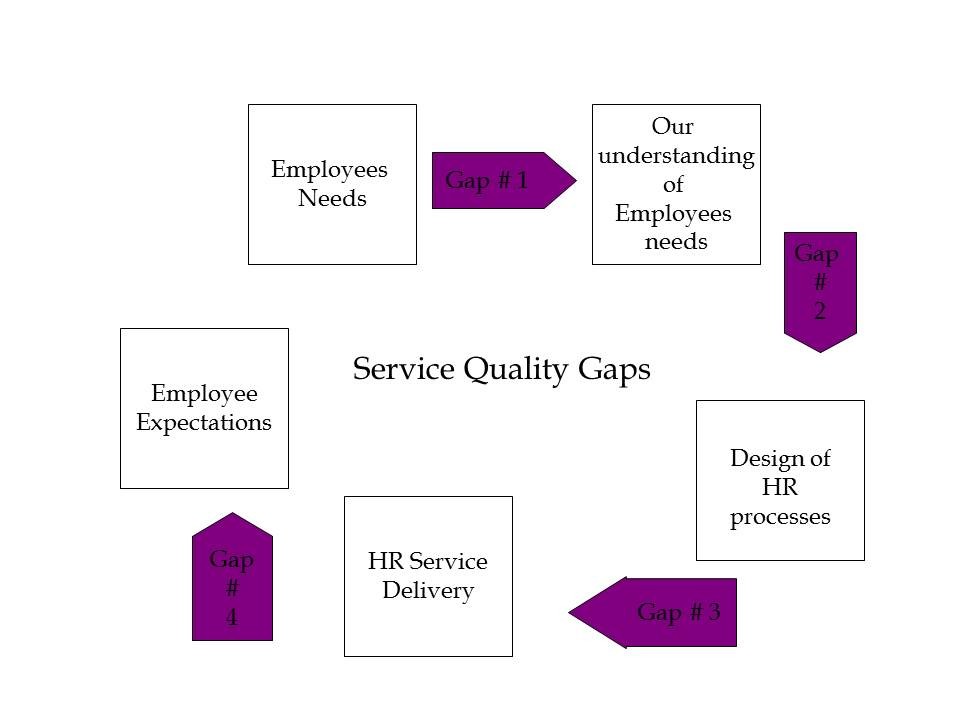
The first gap is between the real needs of employees and our understanding of these employee’s needs. This gap can exist on account of poor action research, employee sensing, the voice of the junior HR professionals not being heard by senior HR leaders and CHROs and having too many layers or silos within the HR function. The worst cause for this is the tendency to embrace some pop sociology trends like “managing the millennials” without any deep research about what it means to your organisation.

The second gap is between our understanding of our employees’ needs and the manner in which we design our processes policies and products to address these needs. This gap can arise when we don’t really show commitment to meet employees’ needs or we dismiss them as unreasonable or just have an exploitative relationship with our employees.

The third gap can occur on account of the difference between what we have designed and how it translates into delivery on the ground. This can happen because of role ambiguities and conflicts between CoEs, business partners, employee partners the shared services staff and line managers. It can also happen because of the lack of motivation of the HR team. It can also be a result of the HR team not being trained or feeling good about their work. It can also be on account of a limited number of team members trying to do too many things at the same time.

The final gap is caused by the difference between what we promise to our employees and what we deliver. Quite often despite our best efforts to deliver we might leave employees unhappy because of our inadvertent propensity to make tall claims and promises in the public domain or in our employee communications. In a world with an overactive social media, this can become a liability.

As organisations become larger and more complex and the business environment becomes more uncertain and competitive, it is my belief that employer brands and employee engagement will depend to a large extent on our ability to close these four gaps so that what we consider functional excellence does get translated into service quality, in the eyes of our employees.

← Go Back

Recent Posts

  • What Outliers Do
  • Who will do your thinking, you or AI?
  • How do kids discover their ikigai in an era of affluence
  • The human spirit as a shared signal
  • How do you reward moonshot performance?
  • Home | CFI – Leadership Coaching | Creating Coaches and Mentors
  • CFI Story
    • About CFI
    • The CFI Story
    • CFI Team
      • Executive Team
      • Chapter leaders
      • Practice Leaders
      • Program Facilitators
      • Coach Certification Panel
    • Guiding Lights
  • CFI Way
    • Why CFI
    • The CFI Way
  • Contact Us
  • Our Coaching Led Development Solutions
    • I need Coaching Support for My Organisation
      • Coaching for Leadership Transition
      • Coaching for Peak Performance
      • Coaching for Succession
      • Leader Development Program for Future Leaders
      • Women Leaders Development Program
      • Coaching Oriented Leadership Program
      • Fostering Team Effectiveness
  • I need a Coach for Myself
  • I am an entrepreneur seeking a business mentor and coach
    • Coaching & Business Mentoring for Entrepreneurs
    • Grooming for Succession in Family Businesses
  • I want to Become a Coach
  • © Copyright 2025.
    All rights reserved.
  • Privacy Policy
  • Created by Mot Juste

CFI defines Coaching as a very personal, humanistic, result-oriented, potential enhancing developmental relationship, structured between an executive seeking to further their growth and a formally trained, skilled and empathetic coach.

Coaching aids leader development but is not therapy and is not intended to treat any form of mental illness.


work well, live well

Logo
  • Nova
  • Hub
  • Coachee
  • Sponsor
  • HR
  • Our Coaching-led Development Solutions
    • I need Coaching Support for My Organisation
      • Coaching for Leadership Transition
      • Coaching for Peak Performance
      • Coaching for Succession
      • Leader Development Program for Future Leaders
      • Women Leaders Development Program
      • Coaching Oriented Leadership Program
      • Fostering Team Effectiveness
    • I need a Coach for Myself
    • I am an Entrepreneur Seeking a Business
      Mentor and Coach
      • Coaching & Business Mentoring for Entrepreneurs
      • Grooming for Succession in Family Businesses
    • I want to Become a Coach
  • CFI Story
    • About CFI
    • The CFI Story
    • CFI Team
      • Executive Team
      • Chapter Leaders
      • Practice Leaders
      • Program Facilitators
      • Certification Panel
      • Mental Health Practitioners
      • Mental Health First Aiders
    • Guiding Lights
    • Our Authors
  • CFI Way
    • Why CFI
    • The CFI Way
    • CFI’s Ethical Promise
  • The Coaching Multiverse
  • Contact Us
  • FAQs

WhatsApp us