One of the most common coaching needs is this – to help a leader think and act more strategically.
Now, the moment one is presented with such a need, one is naturally drawn to connect this with the cognitive ability to think strategically.
In fact most competency frameworks focus on the “thinking dimension” of being strategic.
Viewed in this manner, we as coaches are likely to run into some rough weather.
The first question that might confound us is this – can we as coaches actually help someone develop their thinking skills? Is it not something that needs to be taught over a long period of time? In fact, the various skills associated with thinking are seldom taught in school or college. While we have so many subjects in school and college, there is seldom a subject called “thinking”.
So, given one’s upbringing, exposure, personality preference, intelligence and work exposure, one may or may not develop a wide range of thinking skills.
Also, in the early days of one’s career, the emphasis is on doing – doing lots and doing well. And unfortunately, we lead ourselves to believe that good doing means no thinking.
Given all these complexities, when someone steps into Leadership Coaching, one can often be found wanting in the thinking dimension – and more specifically in the strategic thinking dimension. When organisations refer to “being strategic”, they are also referring to focusing on what is important and vital rather than just exigent.
Having witnessed and seen several hundreds of coaching engagements, my conclusion is that it is not the job of a coach to teach thinking, even strategic thinking. Defined in this manner, it can be a long and complex and even difficult expectation.
What coaches can certainly do is to help the leaders nurture a strategic orientation. A strategic orientation by leading them to develop habits that aid the process of being strategic – that aid them to behave in ways that are more strategic. Challenge beliefs that prevent them from being strategic. Dealing with aspects of emotional intelligence that if nurtured can support the cognitive process. (like being impulsive, not regulating one’s emotions in problem solving and decision making, not being grounded, not being empathetic).These are things that a coach can certainly work with their coachees on. But they cannot make them more strategic thinkers. They can help them become leaders who can be more strategic in what they do and how they do it.
Based on my experiences and the experiences of my fellow coaches, here are a few things that coaches do to promote strategic orientation or good habits to be strategic. I present them in the form of eight questions that coaches can get their coachees to ask themselves.
1. Do I have the time to be strategic or do the strategic or important things? How do I spend my time? Coaches often find that the manner in which leaders spend their time needs change. They might be spending time doing things that are best done by their team members. This is one reason why the ability and willingness to delegate is often linked to the ability to be strategic.
This is one area that coaches engage in quite often, in order to promote strategic orientation.
2. How much of my time is spent thinking?
Many leaders grow up to believe that a packed day busy “doing” things is the best sign of being effective. The limiting belief that working hard is necessary and being seen as working hard is important is often common. So, having empty spaces in one’s calendar and using it to think can often be seen as a sin.
Overcoming this limiting belief and getting into the habit of reflection is another thing that coaches work with their coachees on.
3. Am I able to view my role and my work situations from perspectives broader than they are today – perspectives that are broader and more holistic and keep the context in mind?
Quite often, in conversations that a coach has with a coachee, the coach will be able to spot views that are somewhat myopic, narrow, or just limiting. They might define their roles in a certain way, they might fail to read the context, they might miss certain facts or choose not to see them. They may not even feel empowered to think about larger matters – that is not my job; tell me what I should do. So, the sense of agency can promote strategic orientation.
As a result, their perspectives may not be strategic. In other words, one’s language defines one’s world. Coaches can help coachees change their language in a way that they are more expansive, holistic and broad.
Altering beliefs, world views and ways of looking at one’s role and the world can help.
It can also be about understanding the strategic plans of the Organisation and seeing what role one can pay to achieve it.
4. Am I articulating in ways that are far sighted, inspiring, clarity promoting or do I end up muddying the waters, talking only actions and what is in front of my nose?
The manner in which one communicates reflects the way one is processing things. It is this communication that gets picked up be key stakeholders and used as pieces of evidence to judge if the leader is strategic or not. And often in a somewhat hasty manner.
Coaches often help their coachees be more thoughtful and prepared and deliberate in the way they communicate so that they elevate conversations, bring clarity and lead to inspiration.
It could be about describing the future of one’s industry, one’s function, asking questions that promote thinking, speaking in a way that others listen, being reflective so one can bring much needed clarity. It could also be about being more intellectually rigorous.
Leaders solve problems in ways that are different. Some do quick fixes. Some go to the root cause. Others question fundamental assumptions and start by saying everything is up for questioning.
Coaches may be called upon to help coachees solve problems in ways that are befitting their positions. This might call for challenging assumptions, asking deep questions and overcoming fears.
6. Can I plan for the long-term?
Planning for the long-term calls for reading the environment, spotting trends and opportunities, making assumptions and seeing patterns.
Coaches are often called upon to help coachees make long-term plans for their businesses. This may call for a certain level of coaching and a certain level of mentoring too.
7. How well am I able to build and maintain relationships?
Building and maintaining relationships calls for the ability to step back and view things in perspective – what battles should I pick up, what relationships matter, what is the political landscape, who are my well wishers and who should be and so on. When do I be candid and when diplomatic. When is the truth best not told?
Being naïve about relationships is not being strategic.
8. Am I able to make complex and balanced decisions considering various factors
Making major decisions like redefining business models, go to market strategies redefining purpose and direction are all complex and call for a lot of clear thinking.
This is yet another expectation for leaders and entrepreneurs. Coaches and mentors often support these decision-making processes by asking the right questions and bringing in the right perspectives.
You can see that coaches and sometimes mentors can help their coachees develop a certain strategic orientation, a certain set of habits in thinking and acting and communicating that can push them in the path of being more strategic.
The idea is to not teach them strategic thinking but to support them to act in ways that are strategic.
-Ganesh Chella
Why Don’t You Communicate?
You could be a leader, manager, team member or colleague. How do you know if you are communicating adequately? We are not talking about the effectiveness of communication from a skill perspective but the adequacy of communicating from a relationship perspective in terms of a habit and a sensitivity – the act of trusting enough to share and disclose, keeping people informed, of making the other person feel cared for, feel included, respected and valued. The true judge of whether we are communicating adequate or not is not us but the other person. How well and adequately we communicate in an interpersonal relationship is always “in the eyes of the beholder”. Be it employee engagement surveys and culture surveys about organisations (and therefore leadership) or 360 surveys about individuals or nay other sensing exercise, inadequate communication almost always figures as an area that needs attention. When critical communication does not happen in a relationship in a given situation, the typical responses from the other person are something like this: “You did not tell me”, “You could have told me” “I did not know”, “How am I supposed to know” “You could have taken me into confidence”, “I did not feel included” “I don’t know what’s going on in your mind”, “Why don’t you say something?” “Why don’t you open up and share?” Have you been asked these questions? Have you asked someone these questions? Well, if the expectations are so strong and the relationship is so important, why don’t people communicate? At the heart of this “blind spot” or “failure” if I should use a strong word is the lack of “perspective taking”. The inability to see things from the point of view of the other person. The inability to see how the world might look from that other person’s eyes. This is also called lack of “cognitive empathy”. It is the inability to comprehend how it feels to be left guessing, left wondering, to know that something is going on but you are not sharing, that you are lost in your bubble. The other can feel it and is perhaps sponging your emotional state but remain helpless. Individuals are unable to take the perspective of the other because they are so caught up in their own world. So, irrespective of what is going on, what is holding people back? There could be many things but three come to my mind. Fears Fear is a big reason for people not to communicate and hold back. I am afraid that I will be judged, will be mistaken, the relationship will turn sour, that you cannot deal with what I have to say, that you are too fragile. Of course, the fear of trusting others with my views and opinions and feelings is another huge one. In an increasingly transparent world, leaders are expected to transcend this fear and share what is going on. To deal with that vulnerability is important today. One of the biggest reasons for performance reviews not delivering on its promise is the fear of being candid and open. Beliefs and Assumptions Leaders, managers and team members might be making many assumptions or holding several unhelpful beliefs that prevent them from sharing. You will not understand You will understand You know what is going on and you can wait I will look weak and sound like I want help There is no use The last time I took the effort and shared you did not understand so why try It is better to sulk and get attention than share and get dismissed Often times when teams are working together on projects and there is need for coordination and cooperation, one team members might be working on something but may fail to let others know where he or she stands and what the issues if any are. One of the reasons for town halls and all hands meeting to be seen as a waste of time is the fact that it lacks candour. Intentions Sometimes, people have intentions when they do not communicate. I better get this done and then report. I am still working on it, so let me complete it Do not want to disturb you. I must have something tangible to share. Many enabling functions in organisations like HR and Finance are often accused of not communicating enough. They may have great intentions, grand plans they wish to unfold but no one knows what is cooking. The consequences More often than not, relationships weaken than strengthen as a result of under communication. Under communication can make things look worse than they actually are. It is also a failed opportunity to ask for and receive help It can lead to managers being misperceived as not acting on things. In an Organisational context, it can weaken trust and allow misinformation to spread. Sadly, instead of taking a small simple step like walking across and talking, we might end up inviting an OD consultant to come in and do an intervention to improve collaboration!
-Ganesh Chella
The Shadow Side of Company Culture
We keep hearing more and more organisations talk passionately about “their culture” and how they wish to preserve and protect it.
Leaders and management gurus swear by culture and often quote Peter Drucker who said, “culture eats strategy for breakfast”. So, culture is holy and you might even wonder if there can at all be a shadow side to it?
Culture is powerful and precisely for that reason, from a leadership effectiveness perspective, I would like to raise two uncomfortable questions about company culture.
The first thing that concerns me is that culture is often times used as a filter. Yes, culture is often referred to in the context of “whether a person fits in or not”. HR is called upon to ensure that hires from outside “fit into the culture”.
In a world that appears so seamless, so standardized and where organisations swear to being inclusive and so embracing of diversity, where gig work defines how things get done and attrition is huge and contingent workforce is your real workforce, I often wonder about the place of culture in this new scheme of things. How does “fitting in” fit in with this new world? Who is supposed to fit in? After all, everyone talks about trust, collaboration, being seamless, being agile, being passionate about execution and other similar things.
What it does is pose huge challenges especially for leaders hired from outside – there is resistance, push back and a lot of stress. Unfortunately, the onus is almost entirely placed on the individual to sort out the adjustment issue. Older the organization and more tenured the employees, greater the challenges. This makes me wonder if “being accepting of others” should be one of the cultural pillars for organizations of tomorrow.
This brings me to the second concern and is best explained by the famous adage, “the culture of an Organization is but the shadow of the leader”. Therefore, in reality, when top leaders, especially successful founders say they want employees, especially senior leaders to “fit in”, they are actually asking people to align or fall in line. They are saying that their style defines the culture and they want employees, especially senior leaders to align to their style. The critical element here is of course success. Yes, when they are successful, they run the risk of personalsing reasons for success and believe that it has to do with their magic presence and style and in many gives them the right to make that the default culture.
Now, often times, an inspiring leader’s style and influence on culture can do a lot of good. It can inspire, elevate and excite employees. If the leaders also grow and evolve, they find ways to learn, adapt and ensure that while the core is retained, there are adaptive changes made and such changes show flexibility to new ideas and new ways of doing things.
But, it can also go the other way. Leaders who are somewhat narcissistic and not self aware and pursue their own agendas can end up creating toxic workplaces and believe that it is good culture.
New comers who come in with the hope of driving change often end up colliding, not with others resistance but the leader’s style. That is why building relationships becomes so key to survival for new comers.
So, if you are a founder, entrepreneur and leader, please ask yourself if you are aware of the influence of your style on culture and seek feedback to know that it is functional and not otherwise. Is your style continuing to have a positive impact on the organisational fabric or are you being rigid just because you are financially successful?
If you are a new comer, respecting this reality and building relationships is key because what you might be confronted with is a conflict with a person and not an inanimate Organisation.
If you are a member of the leadership team or HR, you have a role to play in ensuing that “culture” is not an excuse for inflexibility and rigidity. Seize opportunities to talk about culture, respecting diversity in the real sense and remain open to new ways of doing things as long as it builds on the core.
But then, there is a socio-political reality to all this you see.
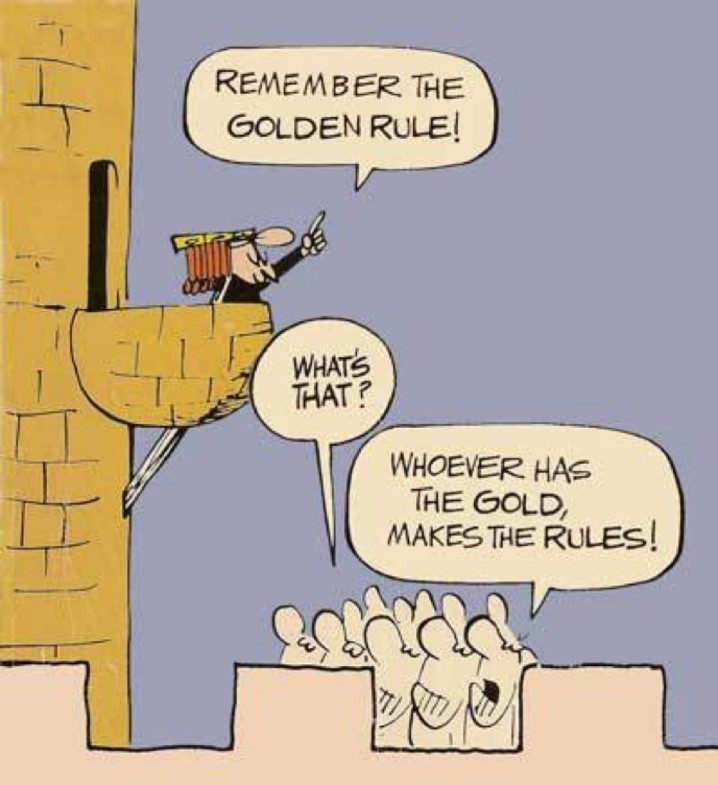
Remember the famous comic strip…..
Credited to “Wizard of Id” comic strip of May 3, 1965.
-Ganesh Chella
The Shadow Side of Coaching Support
Over the years, we at CFI have received several hundreds of requests for coaching support for executives.
Most of them are very well intentioned and have helped yield great results for the individual and the organization.
However, there have been a few requests that have revealed to me the shadow side of seeking coaching support from organizations and sponsors. In other words, below the surface, the underlying theme was not really all about helping the executive or the coachee. It was about addressing other agendas.
It would be important for coach providers, coaches and leadership development heads to be mindful about these traps and avoid them as much as they can.
There are four such traps that I can think of:
We even tried coaching but this person did not change: The organization has almost made up its mind that an executive does not fit and may have to go. Given the seniority he or she is not put on a PIP. Nor does anyone want to be honest with the person and given some clear feedback and outline the writing on the wall. Instead, the sponsors decide that coaching is the most honorable way to pave the way for the person to go. Everyone knows it will not work but they set it up and go through with it. Experienced coaches of course tend to figure this out.
I am senior and my style must prevail: Many seniors who are sponsors tend to have a certain style of working and find it convenient to have subordinates who mirror that style or “align” with that way of working. This can be about intellectual prowess or social skills or speed or attention to detail or affinity for certain things. These seniors find it hard to accept that others can be different from them or can think and act differently or pay attention to different things and still deliver results. Instead of talking about and engaging these differences, they reach out for a coach and ask the coach to “fix” certain behaviours which will hopefully make the executive more like him and less different.
Impress the seniors: Executive councils or even boards have seasoned executives who are accomplished, successful and have been there and done that. They are also impatient, quick to judge and have short attention spans or short fuses. It is perfectly possible for an otherwise competent executive to feel overwhelmed in their presence and end up not saying what they wanted to say, or use twice the number of words to say it, or not make eye contact or use too many slides and so on. Instead of creating a welcoming setting to appreciate the talent that is in front, the council or board may ask that the executive be coached to display greater “executive presence”, “gravitas”, “stature”, be precise in communication and so on. I am not saying that these are not valid coaching needs. They are but they must be intended to help the executive realise his or her potential and not merely compensate for the “rough edges” of the people they deal with or end up creating a culture of “impressing”. The consequences of such a culture are all too clear. “Making a good impression” and “competence” do not always go hand in hand, especially when judged in a brief encounter or through an “elevator pitch”
Square peg in a round hole: Organizations can sometimes get very adventurous in their career development efforts. While it is one thing to give executive diverse experiences, it is another thing to try and fit a square peg into a round hole. There might be a super specialist in a function who may ideally wish to go on in that same path. However, traditional Job Evaluation systems and other considerations might dictate that this person should handle more people, lead a business or manage P&L. The executive reluctantly signs up for this path and in support is given a coach with the hope that the coach will make him or her become the person who that person may not be able to become. After a lot of effort, if the intended change does not happen, there is huge loss of face for the executive and hasty conclusions drawn by the sponsors.
Coaching is certainly a powerful developmental experience and does deliver results. However, it cannot be used to compensate for others’ likes and preferences or policy constraints or sheer inability to speak the truth with the person. Coaches and sponsors can knowingly agree to work with a person who may have many challenges but that must be with due knowledge, honest discussions and clarity about the realistic outcomes that one can expect.
That way, we will be sure that we do not harm the coachee and not earn the coach or coaching a bad name.
-Ganesh Chella
How Coach-Coachee Pairing works?
The most important step in setting up a successful coaching engagement is the process of the coachee finding the right coach.
Be it a single coachee for whom the Organisation needs to find the right Internal Coach Program and executive coaching certification or a cohort of coachees for whom the Organisation needs to find the right panel of coaches, be it finding a coach directly or through a coach provider, or be it a coachee directly trying to find a coach for themselves (typically entrepreneurs and business owners), the process is quite crucial and everyone needs to get it right.
So how does it really work? In my role as a coach provider for over 15 years, I have seen many methods work petty well – yes, there is no single golden way to do it.
Given that it is a partnership and an alliance, we can use the analogy of marriages (merely to bring clarity). When we talk about marriages, we often ask if it love or arranged. The truth is that even in marriages it is not so black and white – there are variations and combinations – there are arrangements and hard facts and then there is compatibility. As far as coach and coachee pairing is concerned, most often it is part arranged and part love. That is perhaps why the term “chemistry” creeps into these discussions. More about that later.
The arranged part
In most cases, there is some kind of a sponsor or facilitator who plays a crucial role in setting up the engagement. It could be the Manager, the leader of the business with active involvement of HR.
Their role in the “arrangement” part is to be rigorous in verifying that the basics are in place in shortlisting coaches.
Often times, sponsors (Manager and or HR) have a very sound understanding of the coachee(s), their needs and preferences. Especially where managers and HR have spent time in formal or informal talent discussions, they are in a position to make an informed choice keeping the interest of the coachee in mind.
Armed with these insights they look at professional credentials and coaching credentials.
Does the coach have the right professional credentials that will help them deliver value to the coachees – a successful career, been there and done that, the rich and varied work and life experiences that will be of value to the coachee. While coaching is “technically” content free, they do look for familiarity with the industry and broad context because that really helps.
Then comes coaching credentials. What is the quality of the coach education program they went through? What has been the track record as a coach? What is the range of work done?
Sponsors will also attempt to gather some references if needed. That can be a great source of comfort.
The sponsors and HR may meet the panel of coaches and then make an informed final selection or a shortlist.
Where the coachee has implicit trust in the Manager and HR and genuinely believes that they have their best interest in mind, the coachee will typically go with the coach presented to them by the sponsors. Of course, there is the usual caveat that the coachee has the freedom to meet the coach and turn down the selection should they have a serious concern – something that happens very rarely.
In certain organisational cultures, they let the coachee truly make the final decision. They typically present a panel of maybe 2 coaches and let the coach choose.
Chemistry and compatibility
Now, if a panel of coaches pass through these two vital filters, then confirming the choice or choosing one of them is where good human judgment, gut feel, leap of faith, trust and other subjective factors come to play, because one is now looking at the human side of the coach – the person, the being. This is the chemistry part, or in our analogy the “love” part.
So, what does chemistry or compatibility really mean, from the coachee’s point of view?
Good chemistry and compatibility may mean saying yes to all or at least some of these questions:
Do I feel comfortable in this person’s presence, can be myself, open up and feel comfortable sharing?
Do I respect this person? And does this person seem to respect me for who I am?
Do we have things in common – views, values, concerns?
Do I get the sense that this person will accept me for who I am and not judge me?
Am I eager to learn from this person?
Does this person inspire confidence?
Did I experience empathetic presence and good listening?
Was this person interested in me?
Was there something endearing about this person? Someone I wish to meet again and work with.
Truth is that seasoned and successful coaches are likely to have worked quite a bit on themselves and their “being” dimension. It is therefore fair to say that they will score fairly well on these dimensions. That indeed is the true test of a coach.
Coachees can hit it off so to speak with their coaches in their first interaction or the chemistry can grow over a few meetings. Of course, in some rare cases, it can also deteriorate over time.
In summary, some arrangements (to verify Professional credentials and coaching credentials) and some love (ascertaining adequate chemistry and compatibility) make for a good coach – coachee relationship. This way, the responsibility of making it work is shared by all involved.
-Ganesh Chella
What Developing People Really Means
The ability of any manager or leader to develop the people working for them has always been considered important and even essential. It has been considered a critical competence, a competitive advantage and a key factor in fostering good engagement. It is now evident that employees not only expect it from their managers and leaders but believe that it is perhaps the most important contribution they can and need to make.
Tomes have been written about what it takes to develop people. A lot is now being said about the need for a coaching culture within organizations. 360-degree assessments focus sharply on this competence and unfortunately many managers and leaders come out wanting.
So, it is obvious by now that developing people is easier said than done.
Why so? What does developing people really mean and why is it so hard?
It is hard because managers and leaders need to make fundamental changes in themselves and their values and styles if they need to be able to develop others. It is not merely a skill. It is a mind-set.
There are four fundamental shifts or changes that we as Manager as Coach and leaders need to make if we need to be able to truly develop another person.
Modify our ways of thinking about performance, results, perfection
Most managers and leaders in Organisation have been brought up to believe that they are as good as what they produce and deliver, that they need to be unfailingly competent, that they need to be perfect and nothing else matters.
The tendency to catastrophize about their performance, results and perfection leads managers and leaders to constantly focus on themselves and how they will look and less about their people. As a result, the mind space for others gets restricted. Developing others is not about us – it is about others.
Broaden our understanding of what our people want
Many managers and leaders believe that they “take good care of their people” and that is all to it. They are right that many do take care of people but in a benevolent way. Developing people is not about taking care of them. It is about supporting them to take care of themselves. It is about empowering them. It is about truly understanding what they really want – that they want growth and development and not mere benevolence.
Reinvent our style of getting work done
Managers often believe that it is more efficient to tell than to ask – to instruct than to listen. Time pressures, task demands and a challenging environment are often cited as reasons to tell people what to do rather then let them find answers.
Developing people is all about not prescribing and directing but about asking and that can be a shift that many can struggle with. Yet, that shift is at the very heart of development. Delegation, empowerment and freedom to act are not just ingredients of good style – they are tools for development.
Revisit our relationship with our people
For the first three shifts to happen, we need to start right at the foundation – our relationship with our people. Is it contractual, are they instruments to achieve our results or are they human? Do we show respect, value their competence, see their potential, get excited about their aspirations or we merely engage in transactions?
CFI’s Talent Development Programs starts with developing oneselves – developing an individual’s ability to look beyond their success, anxieties and needs.
Managers and leaders may need help and support to make these shifts and when they do, they will begin to practice the art and experience the joy of developing others.
-Ganesh Chella
Moral High Ground, Emotional Low Road
Have you ever coached leaders who tend to take the moral high ground but do it by ending up taking the emotional low road? And therefore find the need for coaching support?
Maybe a few examples would help throw more light.
People who work for the leader will often complain that the leader is insensitive, harsh, demanding. at times abusive, lacks emotional regulation or has a poor temperament.
As you engage with these leaders, they will tell you that even at their age, they are the hardest working, the ones who turn up first and leave last and wonder why today’s employees are insincere. They will tell you how their colleagues in other functions will run amuck but for their careful oversight. They will tell you that they just cannot tolerate people who don’t have an eye for details, perfection, sincerity, honesty, discipline, professionalism, competence and the list will go on. They will tell you how they are used to telling people the truth on their face and they are ok with it and they feel it is important to do it.
They will tell you how things are just not the same, how the culture has deteriorated, how people today just don’t care about customers the way they used to and so on.
Often times, they might be viewing the world against their standards and always seeing it as failing.
They believe that their way of dealing with it is to tell it as it is, never mind other’s readiness for it, tell it with anger because only if they are angry do people listen, punish people because those who make mistakes must be punished and so on.
As you engage with them, you may even realise that they have similar view about people in their personal lives.
The truth is that from their logical bubble, they are “right”. Unfortunately, they may not realise or recognize that in the process many of the people around them are “wronged”.
Are such people coachable? Of course, they are because they are often toughest on themselves. Unforgiving about themselves. They are talented, full of many virtues and yet transacting with the world in a way that is somewhat dysfunctional.
The core issue is that people with such great talent may perhaps need to focus on being “related” more than being “right”. By being related, they may have a chance that others will feel inspired by their standards, not perspired by it.
The truth is that there is a bit of this in many of us – the thing of being unhappy when the world is not the way we would like it to be. The thing of using our standards to judge others. It is perhaps even automatic. But then, that is why social intelligence and emotional intelligence becomes important. Where we begin to recognize that virtue lies between the extremes – the ability balance our moral standards with our emotional intelligence.
Now, I am sure some of us are wondering if the reverse happens too – emotional high road and moral low road – where individuals make it about how they feel rather than what they did or did not do. Well, that is for exploration another time!
Started posting articles on LinkedIn since 2015. I celebrate my seventh year by starting this weekly post on matters of leadership, people and organizations. Hope it gets you thinking – that is what grey matters is all about!
-Ganesh Chella
Means Matter – Read the Fine Print
Ever so often, we hear the story of a very successful leader’s career suddenly getting derailed.
He or she delivered great results, was celebrated, often even praised in high places.
Everything looked good until it suddenly begins to look quite bad.
For every such story that might be reported in the public domain, there are hundreds that go unmentioned.
Stories of leaders who focused so much on ends and so little on the means until it is too late. “Means” can mean many things but I am restricting myself to styles and behaviours and not treading on matters of ethics and morals.
Why are leaders who are intrinsically mature and balanced sometimes so blind to this reality?
There are several contributing factors to this condition but in this article, I want to shine the spotlight on one particular factor – the role of the Organisation’s culture and what it places emphasis on.
Organisational messaging is loud and clear about results, performance, outcomes, goals and so on. On the other hand, Organisational messaging about behavioural means has traditionally been buried in the fine print.
It was expected that individuals would make themselves familiar with and competent in balancing ends with the means to achieve results even if such expectations were buried in the fine print and easy to miss.
We don’t start our review meetings (of an operational or strategic nature) talking about how we need to get along with others, how we need to treat others, the importance of respect, how we need to manage relationships, how we need to be inclusive and so on. These are taken as read – even if in fine print. The focus is on results and the sub-text is, “just get it done”.
Another aspect of organizational culture is the all-pervading fear about “vulnerability”.
The culture leads many to end up somehow subscribing to what Italian politician and writer Niccolò Machiavelli said in his famous text, The Prince.
“A question arises: whether it be better to be loved than feared or feared than loved? It may be answered that one should wish to be both, but, because it is difficult to unite them in one person, it is much safer to be feared than loved, when, of the two, either must be dispensed with.”
In fact, the greatest fear among many leaders who are training to become coaching oriented is just this – that their teams will see them as too soft and therefore become less effective in getting things done.
It is only when the collateral damage is too high that the fine print is specifically read out to them. And often times it might be too late. Or, even worse, one is read out the fine print when he or she is passed over for a promotion or a big break and that can be very disheartening.
If we are fortunate to have good managers and mentors early in our life, chances are that they would drill it into our heads that we should read and pay attention to the fine print at all times.
The good news is that all this is beginning to change. In a world where everything is open and transparent and everyone is up for scrutiny and every succeeding generation of employees are experiencing far greater power than the so called powerful, it is my view that means will matter more than ever before. As employees vote with their feet, voice openly, where views and opinions can become movements and Boards are being asked to pay greater attention to means, it is my view that the fine print will be the heart of the matter.
And as we look around, there are enough shining examples of organizations moving in this direction.
-Ganesh Chella
Coaches as Wounded Healers
First things first. I am not using the term wounded healers in the same way that Psychologist & Psychiatrist Carl Jung used it.
I am using it in the specific context of coaching to imply that in my experience, the most authentic and effective coaches are the ones who have experienced difficulties and challenges of varied kinds (wounds as I call them) or are perhaps continuing to face them and from those difficulties (wounds) bring out wisdom that can heal others they come in touch with. Perhaps it is that process of having healed their wounds or overcome their difficulties that they feel deeply motivated to help and heal others.
Executive coaches have been executives for long and hard. They have had careers filled with a fair share of ups and downs.
Be it building and maintaining relationships, expressing our emotions effectively, dealing with conflicts, coping with failures, managing our guilt, overcoming our unhelpful ways of thinking, tolerating stress, dealing with career anxieties, navigating the allowable dishonesties of Organisational life, all of us as coaches have had our fair share of highs and lows. This real and authentic experience is what makes for a real coach.
It is through this window of authenticity and through this identity of being a wounded healer that coaches are likely to make the deepest possible connection with their coachees. It is through that first hand experience that we are able to respond or challenge with authenticity because we are coming from a place of having been there and experienced it.
It is not by presenting ourselves as perfect, as having arrived, or as being complete, flawless and exemplary that we make a connection. In fact, presented in that manner may even be intimidating, a sense that I will not be understood or even worse a state where the coachee feels “I am afraid to tell you who I am because you may not like the who that I am and that is all I have”. (John Powell).
So, to be comfortable in my skin with all my gifts and my flaws makes me authentic.
To be able to therefore present myself as an equal and a co-traveler rather than as an expert make me trust worthy.
To however not burden my coachee with my issues and focus on the coachee makes me empathetic.
To seek peer guidance to be sure that I am staying within these ethical boundaries makes me responsible.
To accept all of this and feel good makes me human.
As I write this, I am reminded of the movie Good Will Hunting. Robin Williams as Dr. Sean Maguire really drives home this point.
-Ganesh Chella
Pre-existing Conditions in Executive Coaching
In the field of Insurance, a pre-existing condition is defined as a health condition that existed prior to applying for health or life insurance.
I borrow this terminology merely to describe an often-experienced situation by Executive coaches when they are called upon to coach leaders.
The presented situation is something like this. The Organisation believes that the leader with many years of experience needs to improve his interpersonal relationships and it is beginning to impact his performance and his ability to work with peers and other stakeholders.
A discerning coach will want to know more about the situation before jumping in and signing up the coachee. He will ask how this executive with a successful track record of over many long years is suddenly encountering challenges with relationships. He will want to know what has changed or led to this need suddenly emerging in the life of the leader.
Another typical situation is that the leader is unable to carry his team along. Again, a discerning coach will want to know how this leader was able to lead teams and deliver results for several years. It would be hard to assume that this need to be able to lead a team suddenly sprung up.
I can add to the list things like inability to collaborate, poor managerial effectiveness and so on.
Often times, organisations may seek coaching support for a leader for a need that to them has now become exigent. They ask for a coach and a coach who does not explore the context well enough is likely to sign up the coachee assuming that what is presented is indeed all that is there to it. That it is a need that has recently emerged.
The truth is that managers and leaders may have pre-existing conditions in the form of long-standing competency gaps or difficulties or inabilities.
So, what caused them to become exigent now and how come the leader managed to carry on well all these years is important to explore.
Expanded role demands are one big reason for a pre-existing condition to flare up as a crying need. If a leader was in a stable environment with a few critical relationships to manage, chances are he somehow managed it notwithstanding the fact that he was not good at it and did not like it. Maybe he developed certain rules, had some work around, leveraged certain personal connections, and also relied on his manager to cope with this aspect of his role though he was never good at it. It did not come to him naturally.
He is then found to have potential for a new position based on other criteria and moved in there. Unfortunately, this relationship dimension may assume huge significance. That is when the gap flares up.
Similarly, one could be just okay in leading a team and managed to get by because the team was tenured, matured and there was stability. A sudden change and a manifold increase in team size can lead to the gap flaring up. It is one thing to lead a small team of 10 individual contributors. It is another thing to manage a team of 20 managers.
Similarly, a structural change or environmental change can lead to a pre-existing condition getting thrown up as a huge gap. A founder of a company may have run his business at his own pace for years and suddenly when he seeks funding and an investor sits on his board, he may find him lacking a performance ethic and not driven. Truth is, he may never have been driven in that manner but was fine given the autonomy he enjoyed.
It could also be that the gaps tend to get magnified when leaders have to act out of their preferences. Or use their less developed strengths suddenly.
In summary, many leaders are able to carry on with pre-existing conditions until things change.
Now, lets get back to the coach signing up such a coachee. The important question for a coach to ascertain is if the need was indeed a pre-existing one and what changed. The next logical question is if it is indeed coachable. Or is it a case of someone in a wrong position. If coaching is indeed the way forward, the coach needs to be able to ascertain the coachee’s own awareness of this reality and motivation to address it. If not, the coach may like to dimension the risks of not being able to make a difference.
Coaches are not magicians and may not want to show a certain bravado in claiming that any situation and condition is coachable, with success.
Knowing the context and how the need came about might be useful in ascertaining the possibility of coaching being able to make a real difference.
-Ganesh Chella
Coaching for Executive Presence
First things first, here are a few examples of what typically gets addressed under Transition Coaching for executive presence
While it is popular, it is also one of the most misunderstood areas of leadership competence and coaching so to speak. There are several unanswered questions about how this need came about, why it matters and what it means and so on. In the absence of clarity, I am afraid that there are so many things that coaches may be asked to do to enhance executive presence, all with very good intention but with mixed results.
My views on this subject are by no means the last word but I think it is worth a try.
First things first, here are a few examples of what typically gets addressed under coaching for executive presence:
Helping the coachee dress well Helping the coachee speak persuasively in a seniors’ forum Help the coachee even find the right place to sit in a Board room setting Helping the coachee make an elevator pitch to seniors if called up to Helping the coachee handle social settings with confidence and have things to talk about Helping the coachee define her or his personal brand and what it means Learning ways in which one can exude confidence, learn to be persuasive and assertive Make the right impression with senior stakeholders All of these are certainly helpful tips and ideas to help leaders make the right impact but they emanate from the interpretation of the term “presence” as a physical thing. As a low context way of making impact.
Origins
Things like assertiveness, influencing and executive presence became prominent after India started become globally aligned and Indians had to deal with leaders from across the world, when Indians had to compete for opportunities across the globe or Indians were evaluated based on competencies of global relevance and compared with global talent for local positions.
This is when Indian organisations and leaders became a lot more low-context in their cultural orientation – an orientation where meaning is made somewhat literally by what someone says or how one is seen. India on the other hand is considered a high context culture where meaning is made by reading individuals and situations in context. We did not judge people merely by what he or she said but by where they were coming from.
As a result, how you spoke started mattering as much as what you spoke in more recent times.
In the book Cultures and Organisations – Software of the Mind by Geert Hofstede and Gert Jan Hofstede, the distinction they draw between American and Dutch employers and job applicants has interesting lessons for this discussion.
In this book, Hofstedes contend that in the US, people tend to discount what is stated or seen because people come from a context where it is believed that people generally overstate their credentials and use superlatives. Now, in that context, if someone let’s say from India who is already understated engages with an American and gets discounted further, there can be problems.
Many “strategic stakeholders” including Board members and global seniors who are increasingly interacting with leaders from India may often judge these leaders through their global lenses or form impressions on these leaders based on limited information. It is in this context that coaches were often called upon to ensure that this thing called “executive presence” or “gravitas” or “stature” did not come in the way of an otherwise good leader not being perceived well.
So, often times quickly learning this thing called “executive presence” is seen as a strategy to be “perceived well” and “paid attention to”.
Executive presence and power
Viewed in this manner, executive presence can be seen as “display of power” – the extent to which people are willing to do what you want them to do – the extent to which people are willing to trust you and go by what you say. The extent to which your words count. This is especially with people who do not have a need to listen to you or agree with you and that understanding is important.
It is about making one’s Leadership Coaching abilities come together to make an impact especially under unknown and difficult or even hostile circumstances.
What is it really?
First, I would like to replace the term executive presence with the term leadership presence.
The term executive is a western notion of this being required at executive leadership levels. Viewed in this manner might make it futile because by the time one reaches an executive level, it is almost always too late.
It is also viewed as somewhat different from the act of leadership – as a distinct trait. Leadership presence is all about leadership.
I would like to define or describe leadership presence as the ability of a leader at any level to be mindful about the manner in which they are experienced as leaders by the world around them and take conscious and deliberate efforts to ensure that as they grow and evolve as leaders, the quality and richness of this experience grows with them. The experience needs to be congruent at one level and uplifting and inspiring at another level. This evolving and dynamic element is important because the real challenge is when a leader is growing in position but the way they are experienced does not reflect it.
In my view, Leaders at every level need to be mindful about the manner in which they are experienced and they need to start working on it well before it is a problem.
Viewed in this manner, it is not a separate set of skills and techniques but just a reflection of your leadership – your awareness and your recognition of the place of others in how you are experienced.
Leadership presence goes beyond the current physical presence in the “here and how” and is about seeing the leader in the context of all past collective experiences, in all walks of life. It is about doing justice to yourself and your gifts. It is about your knowing and using your strengths well. It is about balance.
Having said all this, I would like to present some of the ingredients of leadership presence in four parts. I will use the analogy of a simple bank acount:
Feeling rich
A leader’s presence starts with not being rich but feeling rich. It starts with how he or she sees himself or herself first. How much do I value myself and how much do I love myself?
If my own sense of worth is poor, it would hugely reflect in the quality of my presence.
So, feeling rich is the first step.
Knowing your balance
The second step is to know your credit balance of presence. Such a credit balance comes from three sources:
Performance: How well are you perceived to have delivered results on a consistent basis? Professional competence: The extent to which you are respected for your competence in your professional / functional areas of expertise. In the world of today, this includes the body of work that you have created and shared with the people around, your professional points of view on things. Are you’re an influencer of thought? Stories: The extent to which there are positive impressions and stories about you that reflect your leadership. It is very important that the number of positive stories about you far outnumber the negative stories about you. This is indeed a huge challenge because replacing negative stories with positive ones is very hard. Openness to feedback can hugely help here.
Adding to your balance
There are quite a few things which one can do to add to their balance of leadership presence. These are things that one can learn in their work with a coach.
Courage & Openness: The extent to which you are seen as someone who can bring up and communicate on difficult issues sensitively and can stand up for principles. The key word is sensitive. Empathy: Your ability to be mindful, listen, understand and respond with empathy and sensitivity in all your relationships and interactions. It also includes articulating in ways that are engaging and absorbing. Intellectual rigour: Your ability to connect the dots and see and communicated the larger picture including a long-term view and your ability to distill the essence of any problem or issue and articulate with simplicity to promote clarity. Statesmanship: Your ability to see the wider ramifications and show statesmanship and take an Organizational view rather than a narrow functional view. Professional demeanor: The extent, to which you value your and other’s time, are reliable, well prepared for any interaction and display respect. Avoiding debits
There are two things which lead to one’s balance being diminished and bad stories being added:
Lack of self-control and emotional regulation: The inability to maintain grace under fire and remain calm and composed and also control your urges and desires. There are enough examples of leaders who have gone into overdraft because of this. In summary, leadership presence is others experience of your leadership. We need to believe we have the ingredients and have to pay attention to knowing where we stand and how we can grow it.
-Ganesh Chella
Is it the end of the BC (bell curve) era?
I am sure all of you are reading a spate of reports about organisation after organisation announcing their decision to do away with the much maligned bell curve. It now appears that any organisation of repute must be seen as disassociating itself from what is now looking like a horrible mistake. Disowning the bell curve seems to be the most politically correct thing to do.
What started off as the practice of one corporation gained popularity thanks to its legendary leader and soon became “best practice” until someday someone realized that it was wrong.
Was it really so wicked and villainous! If it was, why did the brightest and best in organisations embrace it all these years?
The truth is that fads will continue to rule the world of management. As with all fads, they are bound to go out of fashion. So, if the most admired companies suddenly find the bell curve a bad idea, others do not want to look silly and maintain a contrarian view.
But, these are not the questions and thoughts going through the minds of most employees and HR professionals. The questions they must be asking themselves are:
If organisations are doing away with the Bell Curve, does that mean that poor performers would be tolerated and not fired? Is rank and yank out of the window? Is HR saved from the torture of ensuring that performance fits the bell curve?
Does the banning of the bell curve mean that everyone can be rated top performer and receive huge pay increases from limitless budgets?
Does all this mean that we have returned to socialist ways and have bid goodbye to principles of meritocracy?
The answer to all these questions is an absolute NO!
Well, the bell curve served four purposes – it helped organisations identify its best people; it helped manage pay increase budgets; it helped identify its poor performers who needed to be separated. Of course, it was also used to ensure fairness and equity in the way all this was done.
Truth is that these purposes will still need to be served, albeit in different ways. While most of us will not get to know the internal intricacies or the fine print on how these laudable philosophies get finally translated on the ground, it is not hard to come up with some plausible predictions about what the world will look like post the BC (Bell Curve) era:
Managerial ownership: Many organisations will give their managers at certain levels pay increase budgets and make them responsible for managing within those budgets. The manager is them forced to distribute the pie based on performance data. This will be one possibility.
Dealing with poor performers: Organizations’ latitude for poor performance is often a function of the health of the business. When the going is good, dealing with the bottom is seldom a high priority. However, when the going is tough, organisations do not need the bell curve to identify and separate poor performers. I am sure you have been seeing media reports in recent weeks about several organisations quietly firing employees in large numbers for reasons of poor performance. So, going forward, separating poor performers will be an on-going activity for which the bell curve may not be needed.
Other methods: Organisation might use other methods and models that combine data about performance and potential to categorize employees into various buckets – from the most valuable to the least valuable.
BC loyalists: There are still a very large number of organisations which are struggling to convince their managers to be objective and tough minded in their assessment process and not let their heart rule over their head. Given the inability of their managers to differentiate, these organisations will continue to rely on the bell curve to create a culture of differentiation where none exists.
We said so: Finally, there will be a group of organisations which will have the last laugh and say, “we said so” – these are organisations which firmly believed that mindless differentiation was not a good thing.
To me, what matters is that the principles of meritocracy, differentiation, performance orientation and fairness are administered in the most respectful, empowering and culturally appropriate way. The bell curve is just one way of doing it. If it did not work for your organisation, please throw it away. However, when you throw things away, remember the popular idiomatic expression, “Don’t throw the baby out with the bathwater.”
For decades the Harvard Business Review (HBR) has shaped global thinking about management. Let’s not forget that several legends in the field have shared their landmark ideas through the HBR. So, when HBR says something, all of us as professionals are naturally inclined to take it seriously.
So, when I saw the July-August 2015 cover titled, “It’s Time to Blow up HR and build something new”, I was first shocked and then angered. After I read the editor’s note I realized that the title was really meant to sensationalise by making a catastrophic claim. The editor’s note carrying the title Re-thinking HR sounded more realistic and sat well in my mind.
I then read Prof. Peter Cappelli’s article in the issue titled, “Why we love to hate HR” which I thought had some interesting insights. For one, he conceded that HR bashing was common because, many people in business don’t like HR to tell them what they should do and bashing the function was their way of getting back. I could certainly relate with that.
Prof. Cappelli also goes on to say that the love-hate relationship with HR depended on how much business needed HR at any point. He clarifies that atleast in the United States, given their economic context, many in business believe that they can do without HR. He goes on to clarify that unlike in the U.S, HR is still hot everywhere else in the world. That makes sense too.
Finally, Prof. Cappelli points out that atleast in the US, delivering shareholding value has become more important than addressing the HR agenda and that explains why CFOs are considered more valuable than CHROs.
In the article titled People before strategy in the same issue, Ram Charan and others argue that CEOs have a big role to play to elevate HR and bridge the gap. This is again something I can relate to. They even suggest forming a group of three (G3) consisting of the CEO, CFO and CHRO. This makes sense too.
Unfortunately, even after reading all the articles, I was unable to locate the explosive materials that they claimed could potentially blow up HR.
Speaking for India, I can say this. If Indian businesses have grown dramatically in the last two decades, at least some of that is thanks to HR reinventing itself constantly. If Indian businesses have gotten better at the art and science of adding hundreds of thousands to their workforce and developing and nurturing them, it is thanks to HR reinventing itself. If Indian businesses have been doing a reasonable job of growing talent from within, at least some of that is thanks to HR reinventing itself. Yes, there is a lot we in India can do better on the HR front but we certainly do not need to blow it up.
It certainly maybe time to blow up HR in the United States and build something new. I even think that a few trips to India may not be a bad idea in the re-building process given that the most is happening on the people front in countries like India.
Career choices: downshifting or derailment
Downshifting as the very term indicates means moving from a higher gear to a lower gear in a vehicle. Derailmentis the dangerous act of a rail going off its track.
It requires little intelligence to recognize that downshifting is better than derailment when it comes to vehicles. Unfortunately, it takes a lot of wisdom to recognize that what applies to vehicles applies to careers too.
Careers are always referred to in terms of paths, tracks and ladders. This rather mechanical view of careers stems from the notion that once on a path or track or ladder, there is only one option – to keep moving forward or upward; there is no getting down or slowing down. This notion of being devoid of choice makes the individual look like a prisoner. Even worse, it attaches a value judgment on anyone who stops, slows down, takes a pause or gets off momentarily.
As a result, in a vibrant economy like India, more and more executives are confronted with the need to decide what they will do in their ladder or path every two or three years. Because every two years, they are lured with hard to refuse invitations to shift to a higher gear or climb more steps even if their hearts plead with them to take a pause or their heads tell them that they are not ready for this. For most executives, not doing anything or turning down an invitation does not appear to be an option.
Some succeed in the choices they make while many others fail because they may accept jobs for which they may not have the competence or may join work environments that do not suit their value system or may sign up to work with managers whose style is incompatible with theirs.
These issues become extremely stark as executives become older because they fail to attach a higher monetary value to their life stage need for congruence where they can say and do what they feel. They fail to attach a higher monetary value to their need for meaning. They fail to attach a higher monetary value to their need for respect and regard for who they are.
Many may also fail to make a realistic assessment of their emotional readiness to live with the inevitable dishonesty of organisational life, especially at senior levels.
Once in the face of these realities, they recognize that they just cannot handle it and call it quits. They recognize that they do not fit in with the demands of that higher step in that ladder or that higher gear in the car. Those who do not learn from this experience might blame the corporate world or bad luck and repeat the mistake once or even twice. By then, their self-confidence goes into a negative spiral.
So, what is the way out?
First, I believe that senior professionals, especially nearing executive positions and over 40 years of age must have a very high level of awareness about what they can and cannot do, what they value and what they do not, what is important and what is not. They must also have the courage to accept these realities and not live in denial.
Second, executives must use this awareness to decide when they need to downshift. They must know the limits of their competence including their emotional capabilities and physical fitness and determine when is the right time to shift gears and slow down.
They must have the grace to accept that the corporate world will be the way it is or even get worse but remember that they have the choice to engage with it in a way that works for them.
Downshifting might mean choosing to work in a smaller organisation where one is respected and valued. Downshifting might mean sticking to doing what one is very good at or passionate about and not venture into unknown or unsuitable terrains. Downshifting might mean that one stops choosing jobs that call for excessive personal and family sacrifices. Downshifting might also mean taking a calculated reduction in pay and benefits so that on a sustainable basis, one is still fine. However, downshifting does not mean one is resisting change. It only means one is adapting to it in a harmonious way.
By being perceptive, self-aware and smart in choosing the right time to downshift, executives might be able to build sustainable careers which allow them to move out of restrictive tracks and paths and ladders and take the road less traveled.
My work brings me in touch with hundreds of executives who have downshifted and through that have been able to regain themselves, their identities and the quality of their lives.
My experience also tells me that when one does not downshift wisely when one needs to, one might go through the ignominy of derailment.
We all know which is better, don’t we?
Will acqui-hiring work?
In recent weeks I have been hearing the term acqui-hiring (the practice of buying out a company essentially for its skilled manpower) being used by many of my clients and friends in the entrepreneurial eco-system.
There seems to be a lot of excitement around the discovery of this cool new way of acquiring talent as a package deal so to speak. Whether this will be used tactically or will become an integral part of the talent acquisition strategy of organisations is hard to predict right now. What we can do is to reflect about its efficacy.
Interestingly, the practice of buying out a company for its skills is not new and cannot be credited to the ingenuity of new age technology companies. Companies in the design, engineering, projects, EPC or other professional services space have often resorted to the practice of acquiring a company which has employees with hard to find skills to ensure effective project completion. The process of acquisition was no different from any M&A process as far as the employees were concerned. The ones who did this successfully ensured that they used the skills but also retained the autonomy of the founder by keeping it arm’s length and even encouraging him to do work for others. Such acqui-hiring deals often took the form of exclusivity agreements or JV partnerships or equity investments. Even when it was fully merged, it did not impact employees in any real way.
However, today’s concept of acqui-hiring seems to be somewhat different.
Many of the acqui-hiring targets of today are the entrepreneurial team itself. In other words, many are trying to acquire the entrepreneurs and make them employees. That is where I see trouble.
I would like to share my person example to explain this. I became an entrepreneur and started my consulting practice back in 2000 to honour my need for autonomy and creativity and to give expression to an idea that I was passionate about. It was not the money or the security that I was looking for. A few years later, I was approached by the founders of two larger consulting firms with proposals to “acqui-hire” me. It did not take me too long to say NO. The whole idea of “going on my own” was to “be on my own” and not “be owned by someone else”!
Having worked with dozens of entrepreneurs over years, I can say with conviction that most of them went on their own for pretty much the same reason – to be on their own.
So, how would they like being acqui-hired? I can say for sure that if someone is truly entrepreneurial, they would certainly not like it.
A true entrepreneur would rather be in charge and in control than become rich. He would rather struggle to build something he is passionate about than sell out and become an employee and squelch his entrepreneurial spirit. He would detest the very idea of becoming an employee, reporting to a manager, complying with company policies, worrying about performance ratings, career progressions and so on.
That is if he is truly an entrepreneur at heart.
So, how do we explain the current popularity of acqui-hiring? How do we explain the fact that many of today’s young entrepreneurs are willing to be acqui-hired?
Well, the answer to that question can be somewhat discomforting.
In my personal view, a good number of today’s entrepreneurs, especially in the technology space perhaps see entrepreneurship as a means of becoming rich very quickly, carried away by the runaway success stories of a handful of billionaire entrepreneurs in the Bay Area or Bangalore. Given the easy access to funding and the strong prospect of being acquired, they may view entrepreneurship the same way they view a campus job – how much money will I make?
For such entrepreneurs, being acqui-hired might sit very well with their needs and preferences. For real entrepreneurs however, being acqui-hired means giving up their dreams to create, to act autonomously and find meaning and purpose. So, even if they do get acqui-hired, they may struggle to fit in and may perhaps bide their time until they can go back “on their own”.
Leadership councils in a digital world
Every organisation of some standing has some form of a shared leadership platform or forum. These forums are called management committees or executive councils or leadership councils or executive committees. Typically these forums consist of the CEO and his or her direct reports.
At one level, belonging to such a form is a badge of honour. At another level, making such a forum really work is at most times an uphill task for its convener, typically the MD or CEO. More about this in a moment.
The purpose of these forums
Boards and business leaders realize that leadership is seldom a solo act. To align the entire leadership team, to get the organisation to benefit from the collective minds of all leaders to solve critical problems, to influence and include them, to co-create the future and to make the best decisions and shape the right strategies such a forum becomes the foundation.
In operational terms, these forums discuss and shape organisational goals and priorities, annual business plans and financial budgets, review progress against these plans, discuss a wide range of issues impacting organisational effectiveness, review talent and other matters relating to people. Needless to say, these forums are expected to stand together and deal with the many inevitable problems and challenges faced by the organisation.
These forums especially serve as important platforms for enabling functions like HR, Finance, Information Technology and so on to get support or draw attention to matters that transcend functional and divisional boundaries.
Simple functional organisations which roll up to the CEO tend to find it easier to secure alignment in these forums as opposed to organisations with business division structures where the head of one business division may find little interest in another business division other than getting to know or keeping others informed or sharing scarce resources.
Current Realities
A lot of my organisation Development work is to do with making such leadership groups work better! That says a lot about these forums, doesn’t it? We often witness either substantive or interpersonal differences among team members in these forums. While some groups do manage to move from forming to storming to norming and performing, small changes in their constitution including the entry of a new member or two or even worse a new leader can throw things out of sync and send them back to forming and storming.
While some will accept that they have difficulties in making these forums effective, many tend to live in denial and depend on a formal structure and the bureaucracy of the process to keep these forums barely functional. But in reality, many of its members just don’t enjoy being in each other’s presence.
Beyond all this is the larger question – in the age of agile working, rapid and disruptive changes, globally diverse teams and the advent of collaborative technology platforms, what purpose do such forums in their physical form with all the ceremonial trappings really serve?
Factors that impact effectiveness
If these forums are really so important, why is that many don’t work as intended? What comes in the way?
Decision making style of the CEO
If the CEO who in many ways is the convener of the forum is autocratic or at best consultative in style, he is unlikely to bring issues to the forum for real discussion or even worse have predetermined views on how things should be done and can make the forum look like a pointless charade.
Many CEOs seldom have the human process facilitation skills needed to make such groups self-sustaining.
Lack of trust and interpersonal comfort
Quite often, members of the forum struggle to get out of their role boundaries and connect with one another as human beings and individuals. Members may feel unsafe and uncomfortable to open up.
Lack of openness
Members may also not speak freely and openly or may not debate and disagree openly. They may also believe that it is best not to intrude into the territory of another peer lest he takes him on when his turn comes. ‘Why mess around with another’ might be the attitude. So, real discussions may not take place.
Lack of ownership for decision made
Often times, decisions may be made in these forums but not carried through. So, the same issues get debated again and again, making team members feel frustrated. Everyone might agree to do something while they actually don’t feel convinced. As a result, results are seldom evident.
Interdependence
Team members may not ask for help or offer help to their colleagues. Everyone may have the need to come across as self-sufficient or ever competent and not show their vulnerabilities. There may also be a sense of competing and winning.
Form overtaking function
Finally, the whole procedural demands of having meetings every month and filing reports may overtake the real function of shared leadership.
The good news is that these situations can easily be reversed should the CEO accept that there is an issue and have the will to set things right. The field of OD is full of methods, tools and frameworks to help in such situations. CEOs can also be coached to promote shared leadership.
Modern organisations in modern times
My real worry is not about making existing Leadership or executive councils effective. The real worry is whether these forums serve any real purpose in their current form. That might sound quite an audacious statement to make but let’s examine it.
At a time when digitization is radically changing the way information is processed and decisions are made, what purpose can a forum that meets once a month with a packed agenda really serve?
In other words, are leaders in these forums leveraging other real time technology based collaboration platforms to exchange views and ideas, debate on issues, brainstorm, take decisions, communicate with one another and truly demonstrate shared leadership?
In my view, the typical monthly meetings will need to transcend their current purpose and serve to build bonds, enhance trust and have deep conversations. On the other hand, these leaders will need to leverage technology to make their forums and councils truly real time and virtual and ensure that information, support, debates and discussions are real-time.
Of course, members of these forums will need to learn the fine art of having great conversations – an art form that is almost forgotten.
If these don’t happen, these forums are likely to look and feel like the way many boards do – become ceremonial occasions.
Coaching is a practice. Becoming a coach is a journey.
For over two decades, CFI’s Post Graduate Programme in Executive Coaching (PGPEC) has been that journey for more than 345 professionals choosing to make executive coaching a serious practice. It is a journey of personal growth as much as it is a journey of learning to coach - because the deeper we encounter ourselves, the more deeply we can work with others.
Registrations are now open for the 38th batch, commencing in July 2027.