Applied Self-awarneness
Our first brush with enhanced self-awareness through feedback was perhaps in school when our teachers wrote something about us in our progress reports or our friends wrote something about us in those lovely autograph books! Many admit that whet they dust those little documents and read them, they are amazed that many of those comments are still true!
My teachers consistently remarked in my progress reports that my hand-writing was horrible. They alerted me to the risk that despite knowing my subjects, I would score low because those correcting my papers would get frustrated trying to read them.
Several decades later, I must admit that my handwriting continues to remain bad. However, I applied my feedback quite religiously when it mattered the most – during my exams, while filling up forms or writing out checks!
Over the years, all of us accumulate a lot of feedback – through college, our first job, our second job and so on. Such feedback emerges from our performance reviews, off-sites, critical incidents that go well or badly, reviews of the functions or businesses we manage. We also receive feedback from our siblings, our spouse, our friends, our bosses, our customers, our colleagues and countless others in our lives.
In recent times, organisations have begun to invest in generating and sharing feedback through scientific and structured tools and processes like Assessment & Development centres, 360 degree tools and psychometric instruments.
So, there is no dearth of feedback.
Given this feedback abundance, most employees will tell you that they are extremely self-aware, that they know who they are and that the open area in their JoHari window is quite large. But, does all this self-awareness result in positive change? Not really.
In other words self-awareness ≠ change
So, what does it take to convert the huge inventory self-awareness into positive change?
I call this skill “Applied Self-awareness”. In fact, applied self-awareness is as critical as self-awareness itself.
So, what are the essential ingredients of applied self-awareness?
Having a taxonomy around self-awareness
To make all the treasure trove of self-awareness related information usable, we must be able to classify and store it in our heads in a way that is easy to retrieve and apply. I call this the self-awareness taxonomy.
For example, we must be able to see awareness about one’s visible behaviours as different from awareness about our personality. Clarity of this nature will help us see our hard wiring and its manifestation in our external behaviours.
It also helps to appreciate that the purpose of enhanced self-awareness is not to change personality but to pay more attention to those aspects of our personality that we have not paid attention to or is less developed.
Knowing where application matters the most
Self-awareness is of little value unless we are acutely aware of its contextual application value.
We must be aware of the various contexts in which our self-awareness can be of immense value. That way, we can understand how effective we are likely to be in each of these contexts and see what we need to do differently in order to more effective.
Problems and opportunities: A good time to draw upon our reservoir of self-awareness is when we encounter a problem or are presented with a great opportunity. It will help us recognise our contribution to the problem or what it will take to make that opportunity a reality.
Role transitions: Another very major context in which our self-awareness can become extremely useful is when we are making major role transitions. It could be transitioning from being single to getting married or becoming a parent or moving from a campus to a corporate setting or moving from one organisational role to another or taking on significantly larger and more complex responsibilities. During these transitions, our self-awareness can give us a realistic picture of the strengths that will support us as well as the areas that are likely to derail us.
Relationships: Whenever we have difficulties with certain relationships, our self-awareness can warn is about the possibility of things going wrong. It can also tell us what about us and our beliefs and habitual behavioural responses are contributing to it.
Social and cultural settings: Many new social and cultural settings tend to challenge us and put our intelligence to test. Out self-awareness can forewarn us about this and help us prepare ourselves to handle it better.
External benchmarks
Finally, it must be remembered that when we look at ourselves and our awareness against our own standards and benchmarks in terms of performance, behaviours and values, everything will look fine and nothing will seem like needing change.
Applied self-awareness is about applying our awareness about ourselves against relevant external benchmarks and then seeing what needs change.
For example, a Finance professional is likely to evaluate his role through the filters of his professional values and norms and on that basis, believe that he is doing fine and that it is others who need change. Only when he learns to look at himself against the benchmarks of what is expected from him by business or his internal customers will he begin to recognise the need to do things differently. Similarly, a CEO may need to recognise that his own standards might be different from the standards and benchmarks that his external stakeholders are using to evaluate him and his effectiveness. Does he need to respect and value these external benchmarks when looking at himself – absolutely yes!
So, enhancing self-awareness is only a good starting point. There is a lot of hard work called for thereafter if one needs to get the most out of such awareness. So, welcome to applied self-awareness!
Growing leaders from within
From the 38th floor of the St. Regis Hotel the view of Mumbai was romantic. However, the three panelists including Madhavi Lal, Dr. Santrupt Misra and Judajith Das and the distinguished audience including several senior Talent management and Learning professionals and CFI (Coaching Foundation India) Coaches on the 38th Floor were candid to concede that the task of growing leaders from within was not as romantic. The power of the theme, “growing leaders from within – challenges and strategies” and the quality of panelists and participants made the CFI round-table around breakfast a grand success.
After two hours of soul searching reflection and debate several meaningful insights emerged. Here are some of these of the insights presented in the form of reflective statements. I am sure you will find these thought provokingly useful!
Our view of Leadership : The biggest challenge of growing leaders from within emanates from the rather narrow and rigid view that we hold about who a leader is and what it takes to qualify as one. Our pre-occupation with traits and characteristics of great people on one side and our temptation to over-engineer our leadership competency framework on the other side has resulted in the leadership job seeming almost impossible to fill. In a world where business is so complex, so demanding of expertise and innovation and so diverse in contexts there is an urgent need to make our notions of leadership a lot more inclusive, simple and broad based. By making our definitions more aligned to our real purpose we might find more leaders than we do today. In this context the fading preoccupation with engineering and the growing popularity of liberal arts education is a welcome development.
Managing release : At the heart of an organization’s ability to grow leaders from within is its deeply held conviction and value that talent belongs to the organisation and not to the manager – managers cannot hoard talented people. This has to be translated into affirmative policy and programs and cannot be a mere wish statement.
Whether Managers will release or not release their team members will depend on how well this belief is translated into action. It is well recognized that release always leads to disruption for the releasing manager and most managers do not like disruption and will therefore resist release.
Should release be managed through use of force or should it be managed through social processes of alignment to purpose, dialogue and recognition is often a dilemma. Under compelling circumstances, mandates and force might be necessary but, the dialogue process must keep happening.
Nobody is ready: One of the stark realities of growing leaders from within in today’s environment is that nobody internally is ever completely ready for a job. Even your best employees will never be plug and play. There will always be an element of risk and developmental headroom. The paradoxical situation seems to be that the very same leaders who were beneficiary of others placing bets on them, hesitate to perpetuate the virtuous cycle of placing bets on the people below them. They seem to say that they were one-of-a-kind!
Overvaluing external hires: The odds are typically stacked against internal talent as compared to external hires for the simple reason that we know a lot more about our internal talent and don’t think too well about what we know. On the other hand we know so little about external hires from the brief interviews we do but out of anxiety and hope ascribe a lot more to them than they deserve.
Making talent fungible: Meeting our needs from within requires that our talent must be somewhat fungible across functional and other boundaries. In other words, unless a talented person can be utilized in multiple areas he/she will never be an organisational resource. This will call for people to be trained to work across functions. We must also avoid the tendency of making jobs so super specialized that no one can fit into them easily unless found from outside.
Another factor that promotes growth from within is the ability of individuals to broaden their perspectives and world views. This includes the ability to respect other functions and other points of view, adjust to other styles, be able to work with diverse people and so on. This happens only when the individual gets to work with different people and is not stuck with one person for too long a time.
Individual choice: Of course, growth from within will get propelled only when individuals make the choice to offer themselves for such growth opportunities. For this individuals must be willing to take some risks and chances with their careers. These choice making processes can certainly be enabled through early career conversations.
Recognising those who develop talent: Most organizations seem to struggle to find ways to recognise leaders who nurture and release talent. Most performance and reward programs do not incorporate talent development as an important criterion. What is clear is that unless someone takes that personal interest, the grooming process will never happen. The larger question in many people’s mind is this – will we ever reach a time when leaders will be recognised by the organisation and his or her peers for their role in developing and grooming talent.
Role of CEO: While it appears easy to say that the CEO should champion the policy of growing leaders from within, it may be impractical for the CEO to arbitrate every release process. HR and other senior leaders also need to constantly engage in difficult conversations around this subject for this to happen.
So as you can see, growing talent from within is a deeply human and social endeavour – something that organisations will struggle to get right even though they all recognize that it is good for the long term.
The CEO’s HR Schooling
Every new CEO in today’s world will acknowledge that “people” and therefore Human Resources management is one of his or her key drivers for business success. Given this conviction, they embark on or champion a series of interventions in this area.
The manner in which they go about doing this gets me thinking about how these new CEOs developed their views, perspectives and visions about HR as a function. What career experiences and through that frames of reference shaped these CEOs orientation to the HR functions they oversee, I wonder?
This question becomes very relevant because few CEOs are formally trained in or educated about some of the key HR processes leave alone the larger science and art of HR. As a result, many even start with the premise that “anyone can do HR work”, much like Head Chef Auguste Gusteau’s motto (in the movie Ratatouille), “anyone can cook”.
Having worked closely with hundreds of CEOs, as an HR Practitioner, Consultant and Coach I am beginning to form certain hypothesis about this subject which I am now venturing to share!
Concepts as a frame of reference
A large number of CEOs approach HR with a certain conceptual frame of reference. This might be as dated as the “OB” course they studied in B. School or as current as the latest bestseller they read on a global corporation’s cutting edge HR strategies or a master class they attended as a part of an executive education program.
Depending on their learning style, some use it as a source of reference and inspiration while others get wedded to it. Some sadly have great disdain for HR concepts because of the mistaken belief they developed on campus that the best brains focussed on Marketing and Finance, not HR.
First person experience as a frame of reference
Let me share an example here. In one of the global corporations I worked in, I was told that the Head of the Asia Pacific region hated HR guys. Here is why: When he was a young management trainee and was relocating from one city to another and wanted to ship his only prized possession, his scooter, the HR guy quoted company policy and disallowed it. From that day on, his experience of HR as a bureaucratic bottleneck got so indelibly etched in his mind that liberating employees and Line managers from HR became his mission statement.
As I think of this possibility, it scares me no end because a large majority of today’s young employees hate HR. I wonder what view they would take about HR when they become CEOs.
Partnering experience as a frame of reference
When these new CEOs were in middle management positions, many would have had the need to partner with HR professionals to address many of their people management needs and challenges. This could be on issues ranging from large scale hiring, large scale downsizing, turbulent union situations, attrition, morale, productivity and so on.
If they got to work with competent and credible HR professionals who were able to help them solve these pressing people problems and support their success, they would have developed a very healthy respect for the person and the function in general. This sense of respect gets further reinforced if they grew up in organisations which invest in building and implementing robust HR processes to support these professionals.
On the contrary, if they failed to receive such support and had to do things in a manner they know best, they may have ended up believing that such expertise is just not available or even necessary.
Industry and organisational culture as a frame of reference
The kind of industry one grew up in or the kind of organisations one worked in also shapes one’s frames of reference about HR. Certain industries and organisations are more mercenary, materialistic and even agentic in their view to people. Others tend to be a lot more value driven. Depending on where the CEO spent his or her formative years, a certain kind of HR Schooling is likely to have taken place.
Personality as a frame of reference
Beyond all this, one’s personality including one’s beliefs, preferences, character strengths and values plays a huge role in shaping one’s orientation to HR.
So, if you are an HR leader, it might be important to understand your CEO’s HR Schooling – the frames of reference that seem to be influencing his or her view towards you and your work and your function.
If you are a young HR professional, think twice before you turn down that request to ship the scooter – you never know how such a singular act is likely to come back to haunt you and your co-professionals for life!
Altering India’s Doorstep Development Model ……. my wish for 2016 and beyond ……
My wife and I were visiting our relatives who live in a fast developing suburb of Bangalore. Their home like most modern and affluent Indian homes has all the amenities and gadgets and is tastefully done up. Our relatives are doing work that is cutting edge, and are globally integrated given that both their sons are living abroad, working for global corporations. They live in an extremely well maintained apartment complex. It has all the amenities that one would yearn for. The neighbourhood square with its malls and fountains and restaurants was truly amazing. We were really impressed with the global quality of living inside.
It was soon time to leave and head for the airport and catch our flight. That two and half hour ride completely destroyed all the sweet memories we had – traffic jams all the way and the constant worry that we will miss our flight. Once inside the modern airport, it felt truly global once again.
As a consultant and coach my work takes me to the campuses, offices and factories of several large and leading Indian and global corporations. These are always such wonderful experiences. Smart security and reception staff who greet you because they have been informed of your arrival, outsourced housekeeping staff who are constantly polishing the floor and cleaning the rest rooms, liveried staff who serve you endless cups of coffee and tea and hot meals from a long list of options, brilliantly designed office spaces and high-tech conference rooms. Add to this some manicured lawns, patches of green, great food courts, cute looking delis and it feel great. Not to forget the brightest and best minds inside these offices and factories that are doing transformational work with great earnestness. I am always excited about these truly world class experiences.
As I leave these premises and step onto the road, the reality quickly hits me.
I realise that our roads are bearing the brunt of this disjointed model of development. The roads are used for parking scores of vehicles – those in good use and those abandoned. Add to them mounds of garbage that could not be cleared, the homeless who are living there, the hawkers and the traffic snarls and you can imagine the mess. Add a dash of rain and you have an absolute disaster outside.
Having seen this pattern again and again – greatness inside and pathetic conditions outside, I have come to call it “the doorstep development model”. Inside your doorstep – at home or at work or in a mall or a supermarket or Hotel, we are truly world class. Outside your doorstep, the infrastructure from a safety and convenience and cleanliness and environmental perspective could rank among the worst in the world. As a consequence, the problems and associated stress of everyday living is alarming. Getting in and out of any doorstep is an ordeal. Inside the doorstep is an oasis of peace and pleasure.
While I am an optimist I must confess that I do not see this doorstep model changing unless we take radical steps. I do not see the inside and outside existing in harmony anytime in the near future in most of the cities that we believe hold great promise in terms of wealth creation – Bangalore, Mumbai, Pune, Gurgaon, Chennai, Hyderabad and so on. The recent rains and flood in Chennai, my city has only convinced me that this is the way it will be.
All this raises a few thoughts, wishes and prayers for the years ahead.
Climate change touches my life
Until recently, I frankly saw climate change as an event that is attended by heads of states.
Climate change has now touched (actually rattled) my life.
While global dialogues will keep happening, I now realise that it might be useful to get better at disaster preparation. This struck me hard when the city of Chennai seemed to have run out of candles and batteries and Dettol. Maybe every apartment must have a boat!
I am certainly committed to integrating climate consciousness into my everyday living.
Does work in progress (WIP) mean inconvenience?
In the hope that things will be great in the future, I have had to live with a lot of work in progress over the years: hope of great airports, great roads, world class metro rail systems, flyovers, expressways. I try and tell myself that at the end of all the inconvenience will be some great outcomes. My question is this – if WIP is an inevitable part of our life, can it be done without huge and visible inconvenience? I am sure many nations have figured this out. That is my prayer for the years ahead.
Beauty and aesthetics as a state of mind
One of my friends used to live in a wonderful residential complex in a suburb in Mumbai. However, to get to work he had to navigate through roads and neighbourhoods that were not so pleasing to the eye. I asked him how he managed to live with this contradiction and he said he simply wore dark glasses as he navigated the roads. I am sure many of us crave to live in a city which offers beauty and aesthetics – a lot of greenery, a lot of cleanliness and beauty in the way our modern buildings integrate into nature. This state of yearning gets heightened when you return from an overseas trip!
It is my wish for the years ahead that I succeed in my quest for inner beauty and aesthetics and learn not to sweat the “small stuff”.
Exit, voice and loyalty?
In his book Exit, Voice and Loyalty: Responses to Decline in Firms, Organizations and States, Albert O. Hirschman argues that there are two types of response to unsatisfactory situations in one’s firm, organization or country. The first is “exit” or leaving without trying to fix things. The second is “voice,” that is, speaking up and trying to remedy the defects.
He argues that Loyalty can modify the response, causing one to stand and fight (voice) rather than cut and run (exit).
India has seen several of its brightest minds choosing the exit option. However, that is still a small minority when viewed in a national context. For most of us, we are loyal to the cities we live in – this is where we belong. It is my hope and prayer for the New Year that we learn to voice our concerns, become more collectivist in a constructive way, find ways to engage with the Government and administration and together find ways to alter the doortstep model that we have descended into.
The manner in which the city of Chennai responded to the floods gives me that hope. I somehow believe that we will discover in us our deep loyalties to our cities and use that to voice and bring about progressive changes.
That indeed is my earnest wish for the New Year!
Is Executive Coaching as a Career right for you?
Given my involvement with the field of executive coaching, I receive several calls from professionals who are seriously exploring coaching as a career and therefore looking at a coach certification program. Quite often I end up dissuading them from their decision to quit their corporate jobs to become a coach.
It may sound strange that as the co-founder of India’s leading executive coaching institution I should be saying this, but, it is true – the process of becoming a coach might look extremely romantic and glamorous. The whole idea of helping someone and impacting their development feels quite heady. However, beneath all these romantic ideas lie several misconceptions, over estimations and under estimations.
So, if you are considering investing in an expensive Executive Coaching Certification program to become a Coach and hope to build a remunerative professional practice around it, here are a few things you might like to know, especially in the India context.
1. A coaching certificate is a necessary but not sufficient condition
You don’t become a coach merely because you have been certified. You earn the right to become a coach because you have proven professional credentials, because you have been there and done that fairly successfully and for a reasonable period of time. If you are a 30 year old L&D Manager, it is natural that you are excited about coaching. It is a certainty that you will be able to master all the coaching skills and processes and be able to have a good conversation. But the bitter truth is that no one will hire you – certainly not for executive coaching.
Here is the hard reality – there are a large number of young professionals who have spent time and money to get certified but are not getting to do even an hour of paid coaching work and are naturally feeling frustrated. On the other hand, when someone with deep professional credentials obtains a coach certification and approaches the profession for the right reasons, she or he stands a very good chance of succeeding.
2. Aspiring to be a full-time coach may not be wise
It appears that many in the West are full time coaches. In other words, their day job is coaching, very much like a therapist’s day job is therapy. I see many in India attempting to set up a professional practice entirely out of coaching. I am not sure that this work for two reasons.
Firstly, it does not seem realistic for most coaches to hope to be able to win and execute enough executive coaching assignments in a year to meet all their economic needs (except of course for iconic coaches who are in demand and can charge a handsome fee).
Secondly, it may not also be a great idea for someone to do only coaching work. A coach is in demand only when his or her contextual knowledge is current. In other words coaches need to have a current and contemporary understanding of business issues and challenges, of organisational realities, of leadership concerns and so on. Unless they do other work with organisations like consulting, or training or sitting on Boards, they may not be able to remain current in terms of this contextual knowledge.
All things considered, it makes sense for a coach to do other things too.
3. Building a coaching practice ground up takes time.
It is not easy for someone to quit a corporate job, get certified as coach and then set up a thriving coaching practice immediately. Having been in a corporate job, these individuals may not have access to the coaching market. They may also fight shy of promoting themselves. So, it is important to be realistic about this dimension. On the other hand, if someone already has a training or consulting practice and an existing client base, it is far easier to add coaching to their array of offerings. Similarly, if someone is well networked or has assured demand from his or her last employer or current employer (once he or she retires) things can become easier.
4. A non-commercial approach helps
When I look back at a large number of coaches who have been effective in their work especially in the Indian context, one common characteristic has been their ability to view this as a noble profession rather than as a lucrative career option. As a result, these coaches do not watch the clock and give their time freely. They don’t charge by the hour. They are happy to do whatever it takes to help their coachees succeed. They often operate below the radar and are happy with private victory. On the other hand I worry about commercially minded coaches who take on too many assignments, push themselves to complete these assignments fast even when their coachees are not ready, or flash too many testimonials and claim too much credit for things that their coachees actually did.
5. So, who is most suited to become a coach?
Having read thus far, the question in the minds of many would be this – for which segment of professionals is coaching as a career a winning value proposition?
Keeping in mind the Indian context and the current state of evolution of coaching, it is best to approach coaching as a sustainable profession with rewards beyond money. It is best viewed as a professional offering which when combined with other things that one does can make it fulfilling.
It is for these reasons that coaching is emerging as an outstanding option for anyone looking to establish a second career. These professionals are likely to have met their financial needs and would want to do something fulfilling and through that self-actualise. Coaching fits perfectly into this need.
Coaching also fits perfectly for anyone who is a consultant, advisor, trainer, facilitator and wants to strengthen his or her practice with coaching.
Of course coaching as a competence would be hugely value adding to any leader who wishes to enhance his or her style of leadership. It is extremely relevant for anyone in HR who is expected to integrate coaching into their leader development efforts.
So welcome to the world of coaching but tread with caution and with a sense of realism.
Bridging the Service Quality Gaps
In my post of March 25th, I spoke about the gap between functional excellence and service quality.
Using the Service Gaps model articulated by Zeithaml, Parasuraman & Berry in their book “Delivering Quality Service” (adapted for this HR context) I would like to present one possible framework by which HR professionals can bridge this gap.
The authors had identified four gaps which can contribute to poor service quality along with some insightful reasons for the same. You will notice that these four gaps and the reasons are equally true for us in HR.
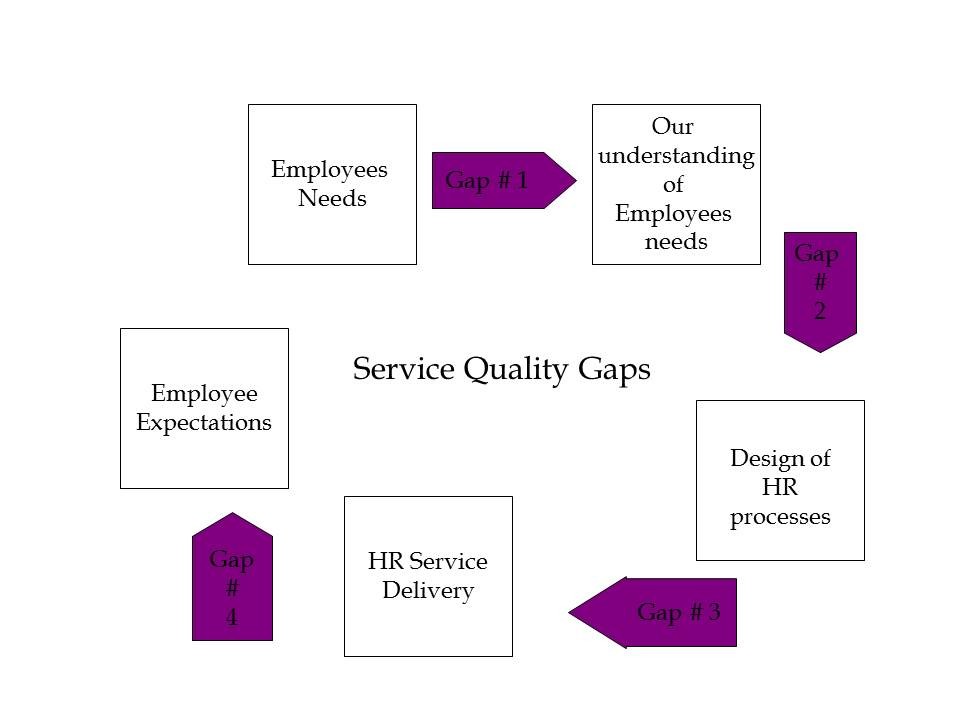
The first gap is between the real needs of employees and our understanding of these employee’s needs. This gap can exist on account of poor action research, employee sensing, the voice of the junior HR professionals not being heard by senior HR leaders and CHROs and having too many layers or silos within the HR function. The worst cause for this is the tendency to embrace some pop sociology trends like “managing the millennials” without any deep research about what it means to your organisation.
The second gap is between our understanding of our employees’ needs and the manner in which we design our processes policies and products to address these needs. This gap can arise when we don’t really show commitment to meet employees’ needs or we dismiss them as unreasonable or just have an exploitative relationship with our employees.
The third gap can occur on account of the difference between what we have designed and how it translates into delivery on the ground. This can happen because of role ambiguities and conflicts between CoEs, business partners, employee partners the shared services staff and line managers. It can also happen because of the lack of motivation of the HR team. It can also be a result of the HR team not being trained or feeling good about their work. It can also be on account of a limited number of team members trying to do too many things at the same time.
The final gap is caused by the difference between what we promise to our employees and what we deliver. Quite often despite our best efforts to deliver we might leave employees unhappy because of our inadvertent propensity to make tall claims and promises in the public domain or in our employee communications. In a world with an overactive social media, this can become a liability.
As organisations become larger and more complex and the business environment becomes more uncertain and competitive, it is my belief that employer brands and employee engagement will depend to a large extent on our ability to close these four gaps so that what we consider functional excellence does get translated into service quality, in the eyes of our employees.
Vales values on the wall the hidden stories do tell them all
You are waiting in the plush lobby of a large and reputed organisation to meet someone. As you wait you cannot but notice the Organisation’s values statement, hanging on the wall. Mounted on an elegant frame the values sound very familiar. Your familiarity soon turns into cynicism. How predictable and trite this is, you wonder. You tell yourself that you see the same phrases everywhere – integrity, boundary less, speed, trust, passion and so on.
How such seemingly empty words can inspire anyone, you ask yourself.
Before more scepticism sets in, your host arrives and leads you into her office.
Sounds familiar? It has happened to me too. Except that my job involve helping teams in organisations articulate such value statements! So, while I am mindful of the risk of such widespread scepticism, I believe in them.
Having engaged with clients in creating, clarifying and communicating organisational values over the years, I have managed to discover some simple truths about communicating values and I would like to share them with you.
Values are universal
Values (those things that an individual or organisation considers important or values over other things) are essentially universal. The world continues to be a good place to live and work in only for that reason. Most organisations and individuals seem to consider more or less the same things as important. So, do not expect some extraordinary truths to be articulated as values. Expect them to be boringly repetitive.
Individual and organisational values in harmony
The values that individuals in the society abide by are not very different from those that organisations believe in. That is why individuals are attracted to organisations. It is this congruence that gives individuals the sense of harmony and makes organisations worthy of spending a significant part of their waking time. In fact, this personal validation is critical for individual to embrace organisational values.
The meanings are unique
While values might be universal and boringly repetitive, the meanings that each organisation attaches to these values are unique and different. For example, while boundary less or collaboration or respect or ownership sounds universal, the meaning it takes for each organisation is likely to be different and set in its unique context. There are likely to be certain unique reasons for its choice as a value and its importance to the business and its founders. These unique meanings are not often apparent.
Behind the words are some great hidden stories
When founders, entrepreneurs or groups of leaders or employees come together to define their values, the most natural thing for them to do is to talk about the times when the organisation and its employees did extraordinary things or did things in extraordinary ways. These founders, entrepreneurs or leaders or front-line employees are likely to relive some great moments in the organisation when magical things happened. They will share several stories and first hand experiences that illustrate these values – stories and experiences that often become part of the organisation’s folklore.
So, you see, behind those seemingly clichéd words are some fascinating stories of times when the organisation was at its best – times when people chose to live by the values.
As Organisations grow, founders, entrepreneurs and leaders wish that such legendary stories happen all the time. They are keen that they retain and reinforce the value system on which the organisation was built. Their intention of inculcating and communicating values is therefore noble.
The question is, how do you execute this great intent? How do you help the new employee who walks into your door to understand, appreciate and live your values?
Certainly not by framing your values and hanging it on your walls or making screen savers out of it. That does not really help because these employees will see it as empty words.
On the other hand, if you can get them to go behind the words and discover those legendary stories, listen to the folklore and feel proud about the times when the organisation and its employees did extraordinary things by living the values, you would have inspired them to live the values too.
This is what I often try to do when invited to work with Organisations and their values.
That is why I say, “Vales values on the wall, the hidden stories do tell them all”
Now coming back to the visitors in the office or the website. Communicating values to them is meaningless. What your customers and visitors need are first hand experiences of the fruits of those values – like great service, great products, wonderful treatment, ease of doing business and so on. That way, they can add to your folklore rather than mock at what is hanging on the wall.
Workman, personnel, human resources or talent?
Talent, Resources, Human Capital – well, you can use any fancy term you wish to, but a Labour Court in Chennai recently held that a Senior Service Programmer of HCL Technologies was a workman under the Industrial Disputes Act – period.
While the company argued that the software engineer was in a supervisory position and on that count did not fall under the purview of Labour laws, the court did not agree.
“It cannot be denied that the job of an engineer in a software company involves skills and technical knowledge. Therefore, it can be easily concluded that the job of a software engineer can be termed as skilled or technical one,” said first additional labour court presiding officer S Nambirajan.
Rejecting the company’s objections, the judge said the software engineer was indeed a workman. According to the Industrial Disputes Act, “workman” means any person employed in any industry doing any manual unskilled, skilled, technical, operational, clerical, or supervisory work, for hire or reward, whether the terms of employment be express or implied.
His order read: “The Company has not produced any evidence to show that failure to improve the performance or failure to measure up to the expectations or standing orders of the company would amount to an act of misconduct. It is not known whether the company has any service rules and regulations, and it has not produced any materials to show what acts constitute misconduct.”
This is not the first instance in which a court has held that IT engineers are workmen. In January 2015 the Madras high court restrained software major TCS from retrenching an employee who had been issued termination orders by the company. The employee moved the high court saying the retrenchment move was illegal and in gross violation of Industrial Disputes Act, 1947.
Admitting her petition, Justice M Duraiswamy granted a four-week interim injunction restraining the company from retrenching her.
In her petition, the employee said she was a ‘workman’ within the meaning of Section 2(s) of the Industrial Disputes Act, 1947, as her main duties and responsibilities are technical and clerical in nature.
Well, the hard reality is that the IT industry in India which recorded revenues of USD 146 billion in FY 2015 with exports slated to reach USD 98.5 Billion and a workforce of 3.5 million, is not governed by any national labour legislation except the local Shops and Commercial Establishments Act!
A few attempts by the Government of Karnataka around the year 2012 to bring the industry under the purview of the Industrial Employment Standing Orders Act was given up with the Government finally granting it exemption for another five years effective January 2014.
So, with no sensible legal framework in place to guide employers and protect employees, we are beginning to see a series of individual such cases springing up to set precedence for more and more likely to come in the coming days.
All major and significant industries in India are covered under an industry specific legislation. So, factories are covered under the Factories Act, plantations under the Plantations Labour Act, mines under the Mines Act, port workers under the Dock Workers (Regulation of Employment) Act, construction workers under the Building & Other Construction Workers (Regulation of Employment & Conditions of Service) Act, and so on.
The Shops and Commercial Establishments Act which was really intended to address the needs of small units of establishments like a retail shop or trading establishment, a bank, an office or a hotel, restaurant, a cinema or any other place of public entertainment is hardly the right legislation to cover the IT industry.
For an industry with such great talent and such a huge equity with the Government and all other stakeholders, it should not be too difficult a task to come up with a world-class legal framework.
Such a framework should cover the obvious areas like working conditions. It should also cover the contentious issues relating to grievance redressal, termination and disciplinary procedures. Most certainly, industry should be empowered to terminate employees with due notice should there be a need.
I believe that a sensible legislation will only further enhance the image and stature of the industry. Since the big firms are supposedly doing better than the law, complying with it should not be difficult for them, just as the hundreds of large and reputed manufacturing companies in our country seldom have trouble complying with the various stringent Acts that apply to them. It might make them more competitive and prevent the less credible sweat shops from setting up and running IT businesses.
I really hope that the current court rulings serve as wake up calls for stakeholders to come up with a proactive solution to deal with what I see as a potentially explosive situation.
I am sure we all remember those wonderful words from Eliza Doolittle: “You see, really and truly, apart from the things anyone can pick up (the dressing and the proper way of speaking, and so on), the difference between a lady and a flower girl is not how she behaves, but how she’s treated. I shall always be a flower girl to Professor Higgins, because he always treats me as a flower girl, and always will; but I know I can be a lady to you, because you always treat me as a lady, and always will.”
So, we can call those millions of human beings who work on software as talent and call our work as talent acquisition and development and engagement and transformation and live in a mythical world, but finally, how we treat them in letter and spirit is what really counts.
Is coaching only for Bad Behaviour?
Several years ago, I suffered from a bad back and after much effort found great relief from consulting a highly regarded homeopath. I was so impressed with his treatment that I referred several back pain patients to him. When I met him a few years later, he thanked me for the referrals but also told me in jest, “Mr. Ganesh, Just for your information, I also treat other ailments”.
What was true for this homeopathic doctor is true for executive coaches too. A lot of popular literature and articles often focus excessively on the role that coaches play in helping their coachees “behave themselves”. In reality, coaches do other things too and it is important that we don’t end up creating the impression among sponsors, coachees and prospective coaches that coaching is used predominantly to correct bad leadership behaviours.
Let’s now get back to understanding what I mean by bad behaviour. Bad behaviour is often associated with lack of emotional regulation and stress tolerance. It is associated typically with Alpha Male executives with an obnoxious style or super competent but emotional unintelligent specialists who are often referred to in a derogatory manner as “brilliant jerks” or even worse a set of senior executives who display what are often called the dark triad personality traits: machiavellianism (a manipulative attitude), narcissism (excessive self-love) and psychopathy (lack of empathy).
Leaders who display such lack of emotional regulation and cause harm to others and themselves needs attention and are often referred to for coaching within organisations. While some of them might actually benefit from therapy, I find that at least in India, it seems more socially acceptable to refer them to a coach. While behavioural coaching or the genre of coaching which focusses almost entirely on working on behavioural changes is an important part of coaching work, I must say that executive coaching is far wider and broader in its impact and purport than just getting people to behave themselves. A much less “remedial” and a much balanced and broader “developmental” view to the power and value of coaching is likely to help put to rest the popular myth that coaching is only for people who have serious behavioural problems and is often one step away from being shown the door.
So, what do sponsors use coaching for, you might ask? Based on my role of being a coach provider for well over a decade and overseeing hundreds of coaching engagements, I have found that sponsoring organisations tend to leverage executive coaching in three contexts or for three reasons:
1. To groom and prepare an executive for a future set of roles and higher responsibilities
2. To help an executive become far more effective in his or her current role
3. To help executives manage their transitions in their roles effectively.
In addition to these three broad agendas that are important for the sponsor, coachees of course bring to the coaching engagement their emerging agendas from their executive or personal lives and seek the support of the coach in whom they have found a trusted helper, in gaining clarity or resolving dilemmas or taking decisions.
In each of these three contexts, we are likely to find coachees who have some immediate problems to solve as well as some future focused aspirations or potential to develop.
Across these three contexts, to help coachees solve problems or leverage potential, they may need to develop skills, revisit their styles, gain new perspectives and pay attention to strengthening certain functional and leadership competencies.
As you can see, coaches have the opportunity to contribute across a much larger plane and across a broader array of needs beyond behavioral changes that are remedial.
Having said all this, I must add that all coaching interventions across all contexts will call for the coachee to make certain fundamental behavioural changes. Without change, no development will be possible. However, such behavioural changes can be positive and developmental and is different from correcting bad behaviour.
The Indian context
This distinction is best understood when we look at coaching in the Indian context.
One of the important drivers of demand for coaching is the sheer size and complexity of many of the emerging leadership roles in functional or business domains. Many entrepreneurs and leaders have never before managed roles with this level of accountability and complexity at such a young age.
Leaders are expected to remain innovative and flexible in the face of deeper, faster and more frequent economic cycles, constant and disruptive technological changes and frequent geopolitical tensions. They are also leading a workforce that has rapidly changing socio-cultural values, needs and preferences. Add to this our cultural context and you see the emergence of a unique set of coaching needs.
For example, a lot of coaching needs for senior executives revolves around enhancing self-esteem and confidence, become more assertive and learning to say no, delegating more effectively by holding on to one’s role boundary, developing a much more formal process based leadership style or present oneself well and display executive presence or thinking and acting strategically.
Effective transition is yet another driver for executive coaching in India. Given the shortage of leaders many organisations prefer to grow their leaders from within. Leaders making such steep internal movements need help to even understand what the transition actually means and get the support to actually make the transition. The most typical transition needs include developing a more effective delegation style, managing a complex web of stakeholders, learning new domains, developing the ability to think strategically and see the big picture, developing the ability to respect and lead other functions, giving up one’s functional loyalty and developing the ability to engage in developmental relationships to nurture talent.
Add to this the problem of missed developmental milestones which is quite unique to India. Generations of Indians have grown within corporate ranks based on their sheer intelligence, ambition and diligence but without some of the fundamental life skills that are expected to be acquired early in life. As a result we find that organisations are filled with leaders who have moved several notches up the hierarchy while carrying the organisational equivalent of academic arrears or backlog in the form of competence deficits and gaps not just from the previous work level but often from several levels below.
So, it is not uncommon to find that a functionally competent senior executive has a need to develop his spoken communication skills, or has to learn to influence, or make decisions with firmness and so on.
So, as you can see, the Indian context presents a unique set of needs as far as coaching is concerned. Add to this the preference for executives to work with a coach who is mentor-like in his or her stature, wisdom and demeanor and you have a rather unique bouquet of possibilities for a coach which goes well beyond getting people to behave themselves.
2020 – the decade of coaching
I became a certified coach in the year 2001 – that is almost 20 years ago. From a time when we had to evangelize the primacy and benefits of coaching, we are now seeing more and more seasoned professionals embrace coaching as a fulfilling career and more and more organisations embracing coaching and preparing the ground for its meaningful application.
As I look at the current state and the days ahead, I am convinced that it is all coming together to create an unbeatably strong and positive trend for the future. I am convinced that 2020 will be the decade of coaching. If you are a coach who has what it takes to deliver value, rejoice – this decade belongs to you!
A decade when coaching will not be sold but bought; a decade when coaching will be consumed not because there are coaches but because it works.
Here are eight strong reasons for my huge sense of optimism about the decade belonging to coaching and coaches.
1. The rise of talent management as a function and the separation of leadership development from learning & development have taken coaching closer to business leaders and their decision making process and away from calendar based training. That means, business leaders are leveraging coaching to solve leadership needs and opportunities with business implications.
2. Coaching as a strong option within long-term leadership development programs has helped coaching earn its rightful place among reliable developmental experiences. While class room training has long existed alongside action learning options, coaching has come in as a breath of fresh air and is holding out great possibilities for bespoke learning and change.
3. Increasingly, Boards and CEOs are beginning to place as much emphasis on means as they are on ends. They are waking up to the reality that the right leadership behaviours are as important as the best business outcomes and leaders having challenges with that are being encouraged to seek help.
4. More and more Boards, Business leaders and Venture investors recognize that given their closeness to the business and their emotional involvement, it is best to give their CEOs access to a coach to grapple with their emerging executive agendas. Support from an outside professional who has the clarity of distance seems well accepted. Books like the Trillion Dollar Coach have just nailed it!
5. From a socio-cultural perspective the average family has had a far higher level of collective experience and acceptance of seeking help in one form or the other. Kids in schools have a counsellor, teenagers are happy to meet one or have one for help. Elders are constantly counselled by professionals about self-care. The word coaching has deeply penetrated our everyday language and relationships and therefore stigma is slowly but surely fading away.
6. We also live a world and time of contradictions – at one level, more and more people are WOKE – are moved by social issues and display compassion empathy. At another level, we have failed or forgotten to display rudimentary emotive empathy to people just around us. So, people will be pushed to “buy listening” from a range of helpers going forward.
7. There are enough positive stories about coaching and related forms of help making a difference. The positive buzz is strong. Those who have benefitted will be the greatest evangelists and propagators of coaching.
8. Changing business models and labour market structures have enhanced the primacy of the individual over the large corporate. The individual is beginning to recognize that it is up to her or him to do what is needed. More and more individuals are now taking charge of their health, their finances, their diet, their leisure, their grooming and of course their development and business after business is being created to make these individual choices possible and workable. Coaching now joins the long list of services that are now within the reach of individuals and most importantly, individual will soon be ready to pay for it.
For these and perhaps other reasons, Coaching is centre stage and will thrive, when delivered well.
So, what are the trends I foresee as far as coaching is concerned? Here are a few that come to my mind.
1. From a ubiquitous and one size fits all practice, significant specialization and applied offerings will emerge to address varied needs and contexts. The format, the durations and the applications will be limited by the imagination of providers.
2. From being tentative and somewhat unsure, HR will reach a place where they will be able to help businesses make well informed decision about coaching. These will be supported by sound internal processes to institutionalize the use of coaching.
3. Coaching will earn the distinction of requiring the highest level of involvement as far as the sponsor is concerned. Unlike training, coaching will require sponsors to play a hugely active and supportive role and that will make coaching a hugely educative experience for sponsors. Thanks to coaching, sponsors will be far better informed about how people learn and change.
4. Team coaching will evolve as a natural extension of individual coaching. This will require coaches to master not just coaching competencies but also group facilitation skills – the interplay of OD and coaching.
5. Coaching will become a critical managerial and leadership competence. As a result, creating a coaching culture and embedding coaching into all conversations and relationships at work will become important.
6. Of course, as with any profession that sees proliferation, concerns about quality and inappropriate application and ethical transgressions will remain.
7. For coaches to be successful, they will need to overlay their foundational coaching competencies with additional skills to address special needs. There will be iconic coaches with a hugely successful track record and reputation and there will also be coaches who will struggle to find meaningful work. This decade will see the growing importance of competence over credentials.
In summary, I think that any leader who is open to seeking help will get help and will no longer have to struggle and suffer in isolation. That will help individuals, their families and of course their businesses do better.
It will also be a great time for coaches who have got it right.
The Candid Generation
I recently went to meet a client to discuss progress on the mentoring engagements we had set up for his two son. A common friend happened to be there in the room at that time. I was waiting for the common friend to leave before we could start discussing the subject. To my surprise the client said, “There are no secrets, he knows my son too” and started discussing progress with the mentoring engagement in his presence. Some candor I thought.
I was shortlisting photographers for my daughter’s weeding recently. When I asked them to show me samples of their work they were all excited about showing me what they called candid photos and videos (the bride and groom in exotic locales, posing for the camera in true Bollywood style). I was particularly embarrassed to see some of the samples. It was just too candid.
At our coaching foundation we go to great lengths to train our coaches on how they should create a trusting environment so that their coachees will open up and speak with candour. We overemphasize the importance of trust and empathic presence. When our coachees report back their progress almost all of them tell us how surprised they were by the candor with which their clients started sharing with them intimate details in the very first meeting almost as if they have known them for years. It was as if they were waiting to pour out and be heard, empathic presence or not!
Turn to organisations and you realise that from a time when appraisals where confidential we now have an overdose of assessments of individuals in all forms with very little to for the executive to hide.
The amount of candor we see in the social media of course needs no belaboring.
As I think about this, I seem to believe that we are in the midst of what I call a candid generation where the lines between what is discreet, confidential, private, public, broadcast-worthy or open are all blurred. There is little to read between the lines or imagine or surmise.
While a lot has been said about the perils of such over exposure, I see quite a few benefits coming out of this.
With a far higher propensity to share, talk and discuss, I am hoping that people’s willingness to seek help when they need it, especially when they are in psychologically troubled zones will be much higher and the stigma attached to those efforts will come down. So, hopefully, people will get help sooner than later and that is very good.
In organisations, leaders and managers will be held increasingly accountable for changing some of their dysfunctional behaviours and habits. The public accountability mechanisms that will be trigged through increasing levels of feedback and other forms of candor will make it hard for people to get away by not changing. In fact, I see many leaders sharing their 360 degree feedback reports, announcing their development plans and presenting their coaches to their teams. Such acts of voluntary public accountability augurs very well for real change.
There will also be increasing pressure on individuals and organisations to be more transparent and candid about policies, practices and decisions. In any case, the CEO is evaluated by scores of people in the public domain every single day!
With a lot more candour and openness, our ability to work across cultures will certainly get better. Things will get a lot more low context.
As I begin to think about it, the possibilities seem exciting.
What do you think?
The template generation
I am with a team of managers in a workshop and the subject of discussion is “having conversations with your team members”.
The managers agree that they will have conversations with their team members. But then they want a template from me for that. What questions should I ask? What should I tell them when I invite them for a discussion? Can you give us a template please?
I am talking to an HR Manager about his writing an approach paper to his Manager about a new initiative. After listening to me he asks, “Can you give me a template?”
I have been visiting this salon for my hair cut for well over three years. The same receptionist has been booking my appointment and greeting me everytime I arrive. But she does not remember my name and asks for my mobile number every single time. Unable to hold myself, I asked her why she was finding it so hard to recognise me or remember my name. Her innocent and spontaneous answer was, “Sir, all your details are in the system”.
If you ask anyone today to write, to document, to present anything they are likely to ask you for a template.
Why have we become a template generation?
Why is it that no one wants to think, to apply their mind and struggle a little bit and create something on their own and of course make a few mistakes?
Well the most obvious culprit who stole an entire generation of cognitive abilities is the computer and all its easy to use software.
You want to write a letter, craft a CV, create a presentation or do any cognitive task of the lowest level of difficulty, there is always a template to help. Sure, template have their value but at a price.
The next big culprit is the organisation that had ambitions of scaling at low cost and therefore saw the need to de-skill jobs, create reusable tools and templates. Sure, it helped achieve scale and standardisation but at the cost of stealing an entire generation for the need to flex their thinking muscles.
Then of course we have the World Wide Web. It holds answers to anything in the world including of course templates for everything in life.
The fact that one can access a template to perform any task calling for even the smallest level of cognitive ability allows people to engage with those tasks with minimum attention. On the other hand, because one has templates for everything, one can easily multitask as one engages with these tasks – one can text, listen to music, chat and even eat.
What templates have robbed us of is not just the need to think but also the spirit of inquiry, the joy of researching something, the warmth of connecting with others to discover, dialogue and create something new.
Templates have also robbed people of their ability to be original, to create, to stand out.
Templates have also led people to believe that all answers lie outside of them.
The culture of templatisation does imply that a few people will do all the thinking and all others will simply act. Perhaps there is an assumption that it is inefficient for so many people (especially in an organisation) to think.
Unfortunately, the very same organisations that popularise templates also ask their employees to be innovative. Unfortunately, these employees struggle to innovate and hope you will give them a template for that!
Appreciating and Amplifying the positive … Does it work for a Nation?
Reading Swamispeak in this morning’s The Economic Times provoked me to ask this question to myself: Does appreciating and amplifying the positive work for a nation as much as it works for individuals, groups and organisation?
To share my answer to this rhetorical question, I will need to take a short detour and talk about Appreciative Inquiry (AI) as a method and a fast emerging movement.
(David Cooperrider, Suresh Srivastava, Frank Barrett, John Carter and others developed the theory and AI method and approach at Case Western Reserve University in Cleveland, Ohio in the 70’s.)
AI as a methodology and philosophy works on the assumption that whatever you want more of, already exists in all organisations.
While traditional problem solving processes tend to look for what is broken, what is wrong, where decay is, AI looks for what is working, where is success, where are best practices, where are the great learnings and so on. AI really looks for what is giving life, what is at the very core. Most importantly, while traditional approaches lead us back to status quo, AI hold the promise of transformational change.
Some of the assumptions of AI are that:
- In every society, organisation or group something works. Discovering that is the starting point of change.
- What we focus on becomes our reality. We can focus on decay and failures, or we can focus on what is working.
- The truth is that there are multiple realities.
- People have more confidence and comfort to journey to the future (the unknown) when they carry forward parts of the past (the known), especially those parts of the past that are confidence inducing.
- Our language creates our reality.
Now back to Swamispeak and what I read today. It was in many ways a celebration of 25 years of liberalisation and what we have achieved in these 25 years.
It was so inspiring and energising for me personally.
This positive image of our nation and what I have been part of is what gives me hope, optimism about the future and fuels me to move forward.
Sure, there are ills, there is decay and there are things we can deplore but choosing to focus on what is working and then dreaming and envisioning an even greater future works far better. It has worked for me, it has worked for the scores of organisations where I have used the methodology and I have no reason to believe that it cannot work for a nation.
Only when we learn to appreciate “what is” and our language reflects that positive orientation will the world around also appreciate and respect us as a nation and as a race, I believe.
Positive Psychology as a science also says the same thing. Our knowledge about psychology can be used to list and call out all that ails human beings – give them labels of being psychotic, neurotic and so on. We can also use the science and our knowledge to list out all that is good with human beings and ourselves – our virtues and character strengths and how we can use that goodness to actualise and be happy.
I certainly believe that by amplifying what works and what is giving life and what our character strengths are, we can certainly create the future that we desire. This is not some feel good stuff. This is science.
Finally, if volatility, uncertainty, complexity and ambiguity are the much talked about ingredients of the way the world is and will be, it is only by embracing and creating an appreciative and positive image can our employees walk with us into the future ahead. That is clearly the most important job of and competence for every leader today.
A warm welcome to BOTs in HR
VUCA is passé. Disruption is the new buzz word. The coolest thing to do is to disrupt someone or something!
It is most cool if what you do can disrupt HR! First, HR outsourcing was the big disruption. That was followed by learning on the go. Then came along mobile apps in HR. Not to forget scrapping the bell curve. Well, that was not enough. Some suggested that HR be merged with Finance and someone else suggested that they blow HR up. Now all that does not still seem to be good enough. The next big disruption is to BOTify HR. (a term I am using to the process of getting BOTs to do what humans in HR did). It is predicted that BOTs will take over a lot of HR work and that millions of HR jobs will be lost all over the world to BOTs. (millions of jobs being lost is a true testimony to real disruption!)
It is envisioned that employees will engage with chatbots for everything from selection interviews to performance reviews to applying for leave to keeping them happy. Wow, that would be the day.
As I listen to and read about all these predictions and disruptive ideas, four thoughts come up in my mind.
What qualifies as HR work: A lot of what has been outsourced in HR so far or what is expected to be BOTified is not want I would call HR work. All of these are employee services of an operational and administrative nature which were at one time performed by clerical staff within the HR function. So, if BOTs will take away all the remaining operational and administrative service tasks – like sharing the same information a thousand times with a smile, then it is actually a very good thing. Maybe many of the jobs in HR shared services might be lost. All this is good because in the first place, these do not qualify as HR work. Even more important, BOTs might do a better job.
Job design in HR: As I talk to hundreds of young HR people, all of them tell me that they experience a huge disconnect between what they thought they would do in HR and what they are actually doing. In the interest of scale and process orientation, the jobs of many front line HR professionals have been shorn of task variety, intellectual challenge, a sense of fulfilment and any form of identity. Many also experience a sense of meaninglessness in what they do and as a result, they may not end up not doing a great job of it. So, if BOTs can take the mundane and the routine out of their work and make their job a bit more enriched, that would be great. So, BOTs are most welcome.
Employees don’t want to talk to HR: There is a fear that employees may miss talking to a human being and things will get dehumanised with BOTs around. Not really. A very large number of employees do not want to talk to anyone in HR even today. In fact, if an employee does not need to talk to anyone in HR, it is a good sign that everything is working the way it should be. On the contrary, in today’s context, if someone from HR wants to talk to an employee, the employee may only get anxious. It is not different from the way we conduct our everyday business transactions through a machine or a phone or app and prefer not having to talk to anyone. So, instead of going to a self-service portal or using an app, if an employee feels comfortable talking to a BOT, that’s great.
Better expectation management: When employees interact with HR professionals, their expectations might often be of instant solutions, a yes to all that they ask, a display of great competence, consistent responsiveness, empathy enough to understand their needs and the ability to show flexibility and responsiveness to solve their problems. When all or some of this does not happen (as is often the case), there is a huge sense of disappointment. It is my hope that when employees engage with BOTs and the BOT says I don’t know, or I can’t do, maybe employees would be more forgiving. The BOT might in fact do a better job of saying no. The BOT may also not have its own need for motivation and fair treatment and even more importantly, not have conflicts with the views and polices and values of top management. So, you see, there might actually be several clever benefits of deploying BOTs to do some of the HR work!
It is my view that in the years to come, there will be far fewer people doing real HR work. A lot of what we misperceive or call as HR work today, will not be done by HR folks and that will be a great thing if it does happen.
So, BOTs, a warm welcome!
The Empathetic Board
An empathetic Board? Does that sound like an oxymoron?
As an executive coach and Consultant I have the opportunity to sit on Boards, present to Boards, be invited to Board meetings and more than anything else, listen to the experiences of many of my clients (founders and CEOs) who frequently attend Board meetings. These interactions have led me to ask myself this question – would it not be wonderful if Boards were empathetic? Will such empathy not make a difference to the executives, their performance and the business?
Am I being too idealistic and out of touch with the hard realities of corporate governance? Well blogs are really a space for asking difficult questions and for pushing the boundaries of what we think is doable. So, here I go!
In addition to the hygiene aspects of ensuring compliance and preventing any form of errors of omission and commission, I believe that Board are ultimately meant to add value, contribute to taking the business and the organisation forward and above all make each meeting a truly educative experience for the members of the management present there – the CEO and his or her team.
So, why do Boards need empathy?
Boards and Board members make their impact and difference essentially through their meetings and interactions. It is therefore fair to say that Boards are nothing but a series of interconnected powerful conversations.
If Board members are expected to use their conversation skills to challenge and encourage CEOs into higher levels of performance, the pathway to such challenge is through inspiration and empathy. To challenge successfully, they will need to show warmth and empathise first – listen, understand and confirm understanding and on that basis unearth blind spots, present new perspectives, new ways of looking at things, new points of views and so on.
Without empathy, the efforts of Board members to engage in a great conversation which includes a fair amount of challenge will be met with a lot of defensiveness and resistance.
In summary if Boards are networks of powerful conversations, empathy is an essential and necessary (but obviously not sufficient) ingredient in such conversations.
What can inhibit empathy?
While I do not have research based evidence to argue if empathy is indeed present or not (and you might be in a better position to ask that of yourself!), I can present reasons for why it might often be missing.
In the minds of the most senior executives including the CEO, the Board is associated with a lot of power and is therefore seen as a hallowed space and accorded the highest level of importance and even reverence. In my experience, such power distance does not augur well for empathy and great conversations. The onus is on the Board to downplay the power and accentuate the relatedness.
Stereotypes about Boards and past experiences with Board members may evoke feelings of fear, anxiety and in some cases even animosity. Of course there are many Boards that inspire.The kind of emotions that are evoked will determine the propensity to change.
The physical setting for Board meetings may not at times promote empathetic presence. Most board rooms are staid, cold, heavy and formal, making the situation look grave even to the most optimistic CEO or executive. Add to this the air of formality and structure and empathetic presence becomes really hard.
Then of course comes the quality of the Board members’ presence? Are they able to give the time that is needed for each interaction and conversation? Or are they hopping from one Board meeting to another?
Then comes their style – do they take the time to understand the business and the executive and show their interest by asking good questions and learning or do they want to don their executive hats and judge the Executives about what they did and what they ought to have done? Do they want to give the executive constructive feedback or just a piece of their mind? Do they seem self-assured or do they want to compete with other members to look good? Do they seem to be in a hurry to say something smart based on anecdotal evidence or would they rather listen intently?
Finally, what is the quality of the relationship between the Board members and the Board members and the executives? Is there mutual respect, an air of genuineness, an air of openness and desire to help?
You see. There is a lot that can inhibit empathy in a Board meeting.
When I meet founders and executives who have a great Board, I can see that they are excited and motivated. They are inclined to speak the truth, show their vulnerability and see Board meetings as educative experiences.
On the other hand, when I meet founders and executives who do not like their Board, they are so stressed at the thought of the next meeting.
To me, the plea for empathy is the journey of governance from the gross to the subtle.
I am sure there are places where this exists. What do you think?
HR Here and Now, reviewed by Prabhakar Lingareddy
“Yesterday I was, tomorrow I will be, but only here and now I am” – Human Angels
A few years back I had the privilege of being invited for a workshop to reflect on emerging trends in HR. It was a very different experience because of the format, the blend of formal and informal moderation and more importantly the pre-workshop preparation done to get all participants on the same page. One had a similar experience earlier with another such workshop on Employee Relations. Why am I mentioning these workshops ‘here and now’? They were facilitated by Ganesh and Harish, who along with VJ Rao have authored the book “HR – Here and Now”. The book is a rich distillation of many such interventions that the three authors have anchored and experienced.
Few months back, I first got to hear about this book when they were collating organizational experiences. Having known all three of them, I am not at all surprised at the narrative style adopted by them – a style that reminded me of Rahul Dravid known for his understated elegance, sharp cricketing brain, effectiveness not only on field, but also off field, nurturing some of the finest young cricketers.
There is something refreshing, something ‘hatke’ in the book, different from many others that I have read in the recent past. And I was wondering why I was getting that feeling – was it a bias of having known the authors, or was it the fact that I could manage reading the book within 24 hrs? I realized later that I felt so because of my alignment with the thoughts expressed, a sense of relatedness with the different contexts and aspects covered, a sense of honesty in upfronting all issues however sensitive they may be, but most importantly, deep down it felt ‘this is all about India and Indian HR’.
Why did I feel so? The answer literally lies in and between the cover pages. Let us look at the cover pages itself to start with. At a time when the trend is to talk of the future, they have opted to look at the ‘here and now’. When the trend is to showcase a macho business oriented HR function, they have chosen to highlight the ‘people champion’. I mentioned about Rahul Dravid earlier – a quintessential people champion. The back page in a way brings out the reason why the content of the book is both reflective and at the same time a practitioner’s guide. To me the book not only aptly answers all the questions listed, but more importantly also answers the question “why does HR as a function evoke such strong and varied emotions amongst people?”
All that one needs to do is to visualize being in a coaching conversation with the authors as you move from page to page, chapter to chapter.
The seven chapters reminded me of ‘7 habits of highly effective people’. Each of the 7 chapters captures the core of an effective HR function. They are written in a manner that any HR professional or people leader can relate to. Books tend to be very heavy for young professionals or too simplistic for experienced professionals. The authors have navigated this challenge very deftly and retained a universal appeal.
So what makes me connect with the book?
· I felt involved as both positive and negative moments of my 30 years of professional journey started flashing by. The reading therefore became a two way process and I experienced a ‘flow’, similar to what Mihaly Csikszentmihalyi defines.
· Most of us have been brought up on 2×2 grids. The authors do not disappoint and two such grids, one based on centrality and helpfulness, and the other based on task demands and business preferences, serve as anchors for all subsequent chapters.
· The thematic approach to deal with all facets of HR gives a ‘story-telling’ feel, taking us on a smooth journey, rather than a gush of a T20 – more as cricket commentators say ‘play session by session’. The theme ‘Doing, Thinking, Feeling’ reminded me of Myer Briggs Type Indicator that was very common sometime back. How CEOs’ perceptions of HR get shaped by their own early experiences of ‘Moments of Truth’ with HR and their ‘Frames of Reference’ was an eye opener and made me wonder how the choice we make in responding to a query can have a life lasting impact for the profession at large. No wonder Stephen Covey said ‘Moment of choice is a moment of truth’. Another interesting theme covered is ‘Spectrum of Relationships’, which could have been elaborated further. The Brakes India case was a very fresh perspective and an example of thinking out of the box.
· A challenge that one sees in today’s context is the ability to link theory to practice. The authors have deftly weaved the same in their narration, be it the timeless Maslow’s hierarchy or Herzberg’s two factor theory or the late 50s work of Michael Young or the more recent studies like WorldatWork Rewards Model or Eliott Jaques Stratified Systems Theory.
· The cinematic start with the serial ‘The Eye of the Beholder’ remains a continued underlying part of the narrative, and the authors go on to suggest that the HR response had and will have to turn to other allied fields as well as its own scientific origins for insights and wisdom. This is also highlighted to a certain extent under ‘professional origins and influences’. The authors end also with a cinematic reference to Auguste Gusteau in the movie Ratotouille.
· As you move from one chapter to another, from theme to theme, not knowing what lays in store, came a wow moment for me. It came because I felt that a topic not discussed so intensely would surely have not been covered even here, and then it just pops up on your face in the next theme. That wow moment was when I finished reading the theme ‘Money and Beyond’. Lo and behold the next theme of ‘Moment of Truth’ discussed the whole topic of service orientation.
· It was heartening to see that focus on Employee Relations was not lost and figured amongst the seven specializations in HR. The tenets of ER got discussed as one of the themes, but the context was really laid out in the theme on ‘Boundaries Redefined’. Coming towards the end of the book, to me it was like a delicious dessert at the end of a seven course meal. I would have however preferred it to be part of the main course, but maybe then the flow would have got impacted.
370 pages may not do justice to a combined experience of almost a century. In their quest to strengthen the HR profession, this book is just one more glorious test match that the authors have played leading their profession to victory. Just like we keep referring to epic innings of cricketers, this book will serve as a good reference for HR professionals of all vintages.
“Mindfulness is not a mechanical process. It is developing a very gentle, kind and creative awareness to the present moment” said Amit Ray. The authors have similarly traversed the path to create the here and now for a promising future. As Soulla Christodoulou said “You have to focus on the here and now. The future will work out itself”.
Prabhakar Lingareddy is Vice President – Human Resources at ITC Limited’s Agri-business. He was on the National Board of NHRD from 2007 to 2014. Prabhakar is an engineer from NIT and an alumnus of XLRI, Jamshedpur.
This book review was originally published in the July 2018 edition of the NHRD Journal.