Functional Excellence and Service Quality
One of the biggest contradictions that I encounter in the HR profession and function is the perennial gap between what is perceived as functional excellence from within and what is perceived as service excellence from without.
When I meet HR professionals they are all excited about the great innovations that they are bringing about in their functional processes and products. They are ever busy rolling out one new initiative after the other all of which according to them holds great promise for the business and its people. When you listen to them you are completely convinced that we in HR are scaling great heights. We are convinced that the function is constantly striving towards higher level of excellence.
When I meet employees across levels in large numbers, I often get a completely contrarian view. To them all our internal efforts to conceptualise, design and implement great products is of little value. Their view about HR is completely influenced by their experience of some of the moments of truth. Many of their complaints, grievances, problems and wishes are very basic and devoid of all the technical mumbo-jumbo. They find something unfair, they find something not working, they see lack of transparency, lack of care and sensitivity, lack of efficiency, lack of responsiveness and of course lack of understanding of their needs. While many do have some positive moments of truth, for a large number, some of the critical moments of truth are negative.
So, as you can see there are two worlds. I often wonder how often these two worlds meet. I am convinced that the great workplaces are the ones where functional excellence is translated into a great service experience as seen by employees. In other organisations the gap between functional excellence and service quality only breeds cynicism. The only way we can bridge this is by ensuring that HR leaders and others responsible for functional excellence have a first-hand experience of the moments of truth and use this experience to shape their efforts.
Capital as Punishment
I must start by clarifying that this article has nothing to do with the subject of capital punishment.
Thanks to many years of work with entrepreneurs and PE / VC firms, I have come to witness the emotional pain that a fair number of entrepreneurs go through after they have raised capital and have given up control. Seeing their pain and unhappiness from close quarters has led me to coin the phrase, capital as punishment.
Entrepreneurs recognize that raising capital is necessary for growth. While most of them intellectually appreciate what it means to give up control to raise capital, very few are fully prepared for its emotional implications. So, while capital is supposed to be nourishment, it becomes punishment at least in their minds. This seems especially true for entrepreneurs who have been in business for a while, are older and have developed a certain attachment to their business and their ways of doing things.
There are at least four reasons for this sad development.
- Accepting accountability: A good number of entrepreneurs who haven’t worked for others or in corporate settings do not understand what it means to be held accountable by someone else. As long as they are privately held they don’t see themselves accountable to others in terms of their business plans, their performance, their strategies or their style. The moment they raise capital and come face-to-face with Investors who begin to ask many difficult questions, they begin to feel miserable. While some might protest that the Investors do not trust them, others will call them unreasonable or out of touch with reality. Only the enlightened entrepreneurs see it as their job to hold them accountable.
- Demonstrating interdependence: Entrepreneurs are generally used to acting in an independent and autonomous manner with little need to consult and include others in shaping strategies or making decisions. Having raised capital, many struggle to respect and honour the inclusion needs of their investors. They may find it difficult to adapt themselves to develop a more inter-dependent relationship. As a result, when investors want to know why they are choosing to do something or how they arrived at a certain decision they might see it as questioning their autonomy.
- Accepting feedback: Most executives grow up in an environment where giving and receiving feedback is a non-negotiable reality. Unfortunately, many entrepreneurs miss this critical developmental experience. As a result, when investors give them feedback, they struggle to accept it with grace. Many hate being told that they are wrong or that they need to do things differently.
- Investor style: In addition to these entrepreneurial blind spots, the style of the investors can also add fuel to fire. If the investors are not emotional intelligent, not trained to have difficult conversations and do not have the time for all this (which can sometimes be the case, given the numbers of board some of the investors sit on) transacting all this can become quite awkward.
As a result of these and other factors, many entrepreneurs end up feeling quite miserable on a day-to-day basis even though the financial upside keeps them going, albeit with a certain level of disengagement. The good news is that the situation can easily be avoided provided there is sensitivity and preparation on both sides.
Two critical preparatory steps come to my mind:
- Relationship before task: It is important that at least one or two Partners or Board members enjoy a trust based relationship with the entrepreneur. Building this foundation of trust is critical before difficult conversations can happen. I have seen many entrepreneurs enthused or demotivated because of one good or bad conversation. A trust based relationship means that the entrepreneur feels respected, sees the investor as genuine and also sees him as having his best interest in mind. This will of course call for time and a genuine intention. Without this foundation of trust, difficult conversations can become dysfunctional. Partners of PE / VC firms may also benefit from being formally trained in the art of great conversations.
- Support in transition: Entrepreneurs must recognize that the process of raising capital and giving up control is a huge and often life altering transition from a psychological stand point and managing it well is not as simple as turning a switch on. Seeking the support of a mentor or coach to manage this transition might be a great idea – even a necessity. With help, they will be able to learn some of the new skills that they may need in managing multiple stakeholders, being more inclusive, being more open to feedback, accept accountability and so on.
When PE/VC firms, its Partners and entrepreneurs act with maturity and preparation, the marriage is likely to be a great success and there are many success stories indeed. If that doesn’t happen it may appear to be as fateful as capital punishment.
I must start by clarifying that this article has nothing to do with the subject of capital punishment.
Thanks to many years of work with entrepreneurs and PE / VC firms, I have come to witness the emotional pain that a fair number of entrepreneurs go through after they have raised capital and have given up control. Seeing their pain and unhappiness from close quarters has led me to coin the phrase, capital as punishment.
Entrepreneurs recognize that raising capital is necessary for growth. While most of them intellectually appreciate what it means to give up control to raise capital, very few are fully prepared for its emotional implications. So, while capital is supposed to be nourishment, it becomes punishment at least in their minds. This seems especially true for entrepreneurs who have been in business for a while, are older and have developed a certain attachment to their business and their ways of doing things.
There are at least four reasons for this sad development.
- Accepting accountability: A good number of entrepreneurs who haven’t worked for others or in corporate settings do not understand what it means to be held accountable by someone else. As long as they are privately held they don’t see themselves accountable to others in terms of their business plans, their performance, their strategies or their style. The moment they raise capital and come face-to-face with Investors who begin to ask many difficult questions, they begin to feel miserable. While some might protest that the Investors do not trust them, others will call them unreasonable or out of touch with reality. Only the enlightened entrepreneurs see it as their job to hold them accountable.
- Demonstrating interdependence: Entrepreneurs are generally used to acting in an independent and autonomous manner with little need to consult and include others in shaping strategies or making decisions. Having raised capital, many struggle to respect and honour the inclusion needs of their investors. They may find it difficult to adapt themselves to develop a more inter-dependent relationship. As a result, when investors want to know why they are choosing to do something or how they arrived at a certain decision they might see it as questioning their autonomy.
- Accepting feedback: Most executives grow up in an environment where giving and receiving feedback is a non-negotiable reality. Unfortunately, many entrepreneurs miss this critical developmental experience. As a result, when investors give them feedback, they struggle to accept it with grace. Many hate being told that they are wrong or that they need to do things differently.
- Investor style: In addition to these entrepreneurial blind spots, the style of the investors can also add fuel to fire. If the investors are not emotional intelligent, not trained to have difficult conversations and do not have the time for all this (which can sometimes be the case, given the numbers of board some of the investors sit on) transacting all this can become quite awkward.
As a result of these and other factors, many entrepreneurs end up feeling quite miserable on a day-to-day basis even though the financial upside keeps them going, albeit with a certain level of disengagement. The good news is that the situation can easily be avoided provided there is sensitivity and preparation on both sides.
Two critical preparatory steps come to my mind:
- Relationship before task: It is important that at least one or two Partners or Board members enjoy a trust based relationship with the entrepreneur. Building this foundation of trust is critical before difficult conversations can happen. I have seen many entrepreneurs enthused or demotivated because of one good or bad conversation. A trust based relationship means that the entrepreneur feels respected, sees the investor as genuine and also sees him as having his best interest in mind. This will of course call for time and a genuine intention. Without this foundation of trust, difficult conversations can become dysfunctional. Partners of PE / VC firms may also benefit from being formally trained in the art of great conversations.
- Support in transition: Entrepreneurs must recognize that the process of raising capital and giving up control is a huge and often life altering transition from a psychological stand point and managing it well is not as simple as turning a switch on. Seeking the support of a mentor or coach to manage this transition might be a great idea – even a necessity. With help, they will be able to learn some of the new skills that they may need in managing multiple stakeholders, being more inclusive, being more open to feedback, accept accountability and so on.
When PE/VC firms, its Partners and entrepreneurs act with maturity and preparation, the marriage is likely to be a great success and there are many success stories indeed. If that doesn’t happen it may appear to be as fateful as capital punishment.
Can Leaders be made to measure?
Here is a typical (but fictitious) discussion in a talent council meeting in a typical company:
You see, Kavish is great at getting things done. His execution is flawless. He is also good with people. It is just that he is just not strategic. He is too immersed in the day to day.
Let’s talk about Ranjit. He is excellent in his functional area. He is very dependable. Unfortunately he just does not have that stature you see. It is hard to put him in from of the Board. A few hard questions and he will begin to fumble.
The discussion then turns even more complex.
Let’s talk about our two Manufacturing Heads – Raj and Kumar. Raj is great with people and very emotional intelligent but does not have intellectual rigour. Kumar is intellectually so goo but insensitive. If somehow we could make an amalgam of both and bring out two manufacturing heads with the best of both, how great would that be?
The world of leadership development and Human Resources management has made great strides in the ability to define competencies, assess leaders against those competencies and quite accurately conclude each person’s strengths and development needs. That is good.
The ability to define what an organisation expects in term of leadership behaviours is also outstanding today. Our literacy on this count is terrific. We can clearly establish the 16 competencies and 24 skills that a leader should possess. That is of course in addition to defining what he needs to know in his job and also what he needs to know about other functions and his business and the business of competitors.
That is unfortunately the problem. The more elaborately and minutely we define what we need from leaders and the more that list becomes longer, the more our existing leaders appear wanting. Assessed against this daunting list, the leaders of even a consistently high performing organisation can come out looking quite bad and give the CEO team some sleepless nights. (if not read in context)
This is no different from the fact that we now have elaborate lists of what good looks are, what good health is, what physical fitness is, what a happy life is and so on. The more we define these standards in almost idealistic terms, the more all of us look bad, feel terrible and think catastrophically. Read those lists every day and you can wake up feeling hopeless.
This is what I call the made to measure syndrome of leader development – the belief that we can tailor make those perfect fit leaders and that for that all we have to do is define on a PowerPoint presentation what we want. On paper, it would be great of a leader had 75 counts of strategic thinking, 68 counts of business acumen, 83 counts of emotional intelligence, 65 counts of executive presence, 72 counts of coaching and mentoring and so on.
Unfortunately our assessment and development centres are likely to turn in results that might disappoint. Until the point of assessment, it is a perfect science. After that, we begin to feel humble.
So, one might ask if the answer is to live with poor leadership or to drop our standards. No, not really. The answer is to emphasise not just competence but also acceptance. The ability to see each executive as a complete and unique person with a combination of abilities and limitations is a great starting point. While the ability to learn all through one’s life is worth emphasising, the ability to respect that each executive will be different and brings unique gifts is equally important.
As a Leader as coach, while I certainly work with my Internal Coaches to help them pay attention to some of their troubled zones, I also feel this strong urge to tell their sponsors to show greater acceptance of their gifts.
The role of defining competencies is to promote learning and not encourage dissatisfaction with what one has. In fact it is this dissatisfaction that pushes organisations to believe that an outside hire might come with a closer fit to their competency definitions that the ones they already have and we all know how that goes.
The truth is that leaders cannot be made to measure. As long as the fit is comfortable and does not pinch or suffocate, that is a good place to be in.
How are you when you are not coaching?
Coaches are human beings – they did not descent from heaven. Coaches also play several roles in addition to being Coaches – they are spouses, parents, children, colleagues, managers, leaders, Board members and citizens in this society.
Their training to become a coach as well as their professional demands of being a coach or coaching oriented leads them to show respect, listen empathetically, respond with understanding, refrain from giving advice and display humility. By and large, when well trained coaches are “playing the role” as coaches or coaching oriented leaders and managers they manage to uphold these values and demonstrate these skills. Otherwise, they may not be in business.
The question is – how are they when they are not “playing the role”.
Let me explain this with a personal example. There are times when I am not fully present or listening attentively when my wife is speaking to me. Sometimes she lets it pass because she realises I am preoccupied and at other times she reminds me that I am a Coach, albeit jokingly. Similarly, my executive responsibility sometimes requires me to give instructions and not remain tentative.
I say this to emphasise that it may not be possible or even necessary for a coach to behave in a coach-like manner at all times.
Having said that, it might be very important for a coach to lead a congruent life. In other words, the manner in which a coach conducts himself or herself “in the role” cannot be incongruent with or contrary to the way he or she plays other roles or lives his or her normal life. So, what are the areas where congruence is an absolute necessity?
1. Whether one is coaching or not, one needs to demonstrate respect. This will include the way one treats others, the language one uses, the regard that one shows and the extent to which one makes others comfortable in one’s presence. Incongruence in this area is unacceptable.
2. Suspending judgement and being more accepting of others is critical even when a coach is not coaching. The ability and willingness to suspend judgement and be more open is crucial. Incongruence in this area is also unacceptable.
3. The propensity to offer advice to others or tell others what they ought to do is most dis-empowering. Coaches must attempt to refrain from offering unsolicited advice irrespective of whether they are playing the role of a coach or not.
4. Whether one is coaching or not, the quality of one’s conversations needs to be superior. A high level of presence, good listening and empathetic response must be present in all conversations, coaching or otherwise.
5. In or out of the coaching role, Coaches need to display a certain level of comfort with self. Comfort enough to not have the need to talk about one’s accomplishments or acts in egocentric ways. Humility is an essential sign of congruence in the lives of coaches.
6. Whether one is coaching or not, coaches need to display a certain hope and optimism about the people around them and their chances for realising their potential.
7. Finally, given that coaches swear by self-awareness and feedback, they must serve as role models when it comes to investing in their self-awareness or receiving feedback with openness and humility.
Coaches are human and are not infallible. Coaches are also not perfect and blessed with all goodness in their life and personalities. The only difference is that, having chosen to become a coach it becomes necessary to constantly ask if one is being congruent and if one is attempting to live up to what one is preaching.
Coaches must get richer by their experiences and be willing to allow the benefit of those experiences enrich their clients.
Coaches must be aware of their shortcomings and struggles and learn from it and must be able to let that learning stand out for their clients.
Above all, coaches must be fully human, fully alive and even vulnerable and through that humanness, touch the lives of the people they come in contact with.
It is by being related and not right that coaches make a difference. Congruence is the key.
The movie Up in the Air explains it all
Ryan Bingham works for an HR consulting firm that specialises in termination assistance – basically firing employees.
Ryan is called back to office to be familiarised with a new program promoted by a young employee Natalie Keener, who now has a web based program to do the termination, to save costs. Ryan opposes it because he considers the process insensitive.
The Tech Mahindra audio clip that went viral has seemingly made the HR lady the cause of all the trouble. I think the issue is much much deeper. And the movie explains it quite elegantly.
If we think more deeply, several realities and questions will hit us hard:
- In the IT industry, employees are not considered employees. They are often and unfortunately viewed as inventory hired for deployment to clients. That is why, in the great days of growth, we adopted supply chain management techniques for managing the hiring process. Now organisations are wondering how to deal with the excess.
- Employees in the IT and other modern businesses liked the “market oriented philosophy” of free movement and and competitive pay for skills when the going was good. Now, a bit of protectionism and a socialistic and benevolent approach seems favoured by them but organisations are not listening.
- Given lack of attachment to any ideology or collectivism, trade unions never took off. What we see is the formation of “interest groups” in small numbers around specific issues using social media.
- Asking an employee to resign or face termination is one of the oldest methods adopted by HR professionals for decades. It was not invented by the IT industry. Only difference is that in the past the HR profession had more Ryans doing it, with experience and maturity. Today, there are very few Ryans left. Young Natalies with scripts are expected to do this. The audio tapes clearly reflect the lack of experience and conviction, a poor reflection of HR leadership, not that individual.
- The issue is certainly not about whether organisations will stop restructuring and laying off. Of course they will. That is the new order. They question is, how will it be done.
- This brings me to the last point. In the coming years, will organisations develop this skill and value or will they outsource the task to firms like the one Ryan worked for or will the wave of technology that is sweeping all of us, offer an automated solution to make this devoid of human contact, like the one that Natalie was promoting?
What is your take?
Too much assessment too little support
If you walk the streets of any of our cities, you will see innumerable scan centres, imaging centres, diagnostic centres and labs and so on.
Talk to your doctor-friend and he will admit in private that there is a huge amount of inappropriate and unnecessary diagnostics that patients are put through. Technology and financing and the desire to establish a business is driving the proliferation of diagnostics.
The field of leadership development is no different.
Talk to any senior leader and he will baffle you with dozens of psychometric assessment reports that he has been subjected to. Ask him what meaning he has made of them and how it helped him and you will only see anger and frustration.
It is my sense that an ever increasing percentage of Future Leader Development budgets are being spent on diagnostics, leaving little money, time and energy for development!
Why are organisations doing leadership assessments with a vengeance so to speak?
For one, immediate managers are unable to delivery high quality, actionable and objective feedback that the employee can pay attention to and act on. Also, many employees who have been successful personalise the reasons for success and feel invincible and choose to live with their blind spots and flaws, often to the detriment of not just themselves but their teams and the businesses they manage. Then there is data from engagement surveys and other sources which might point to concerns about the style and sensitivity of certain leaders. Then of course is the fact that today’s young team members are less tolerant to and accepting of bosses whose styles and approaches are dysfunctional.
So, the desire to somehow get leaders to “wake up and smell the coffee”, to get leaders to become more self-aware, to shine the spotlight on some of their dysfunctional blind spots is understandable and even important. It is also understandable that some of these assessment tools can be very effective in doing this.
However, most talent managers, L&D professionals and HR leaders fail to understand the human and psychological dimensions involved in doing this well. They fail to realise that challenging someone with strong feedback is like throwing a bird off its nest or opening up something hard and unpleasant for a person.
Many underestimate or even ignore the fact that the process of challenging individuals through such assessment processes must be done in a climate of care and empathy and must be accompanied by an equally adequate amount of support to do deal with the emotions it evokes and thereafter help in doing something about it.
Often, firms and individuals who have been retained to assess and debrief the results of assessment tool at best have one session with the employee for about an hour or so to walk the employee through the report – that is it.
To leave a person with assessment data without adequate support is worse than not doing anything.
When assessment is accompanied with support in terms of help in interpreting it, making meaning out of it, dealing with the emotions that it throws up and crafting actions to overcome it, it can be an empowering experience. Such support must come from a qualified helper who can spend at least a few sessions with the person to convert the assessment data into actionable ideas for one’s benefit.
For this to happen the HR team needs to develop empathy. As a first step, all team members in HR must subject themselves to all assessment tools that they plan to administer on their employees. They must experience the emotional stages of S-A-R-A-H (shock, anger, resistance, acceptance and help) first hand so that they can empathise with their employees. When they implement these programs, they must come from a first-hand experience of having gone through this and benefitted so that they are credible and empathetic. (No different from first filling for yourself a KRA form that you design for others).
The real problem with delegation: micromanagement or abdication
The ability and inability to delegate at a level that is appropriate to one’s position in the organisation very often figures as an acute development need for entrepreneurs, leaders and managers across organizations.
Trainers and Coaches spend an enormous amount of time and effort in helping these executives develop the right skills and mind-sets so that they are able to practice delegation in a manner that is befitting their level and context in the organisation.
If the delegation problem were to be placed on a continuum, on one end of the spectrum would be the inability to let go or what is popularly called “micro management” and on the other end of the spectrum would be the inability to remain hands on and take ownership or what is popularly called “abdication”.

Unfortunately, there is a popular notion within organizations that more managers and leaders need help with overcoming their tendency to micro manage. As a corollary, it is believed that abdication is seldom an issue and developmental challenge and has therefore received very little attention among trainers, coaches and even thought leaders. In other words there is an assumption that a vast majority of executives are taking more charge than they should and that we do not have as much of a problem with people not taking charge at all.
My experience tells me that this is a huge fallacy. My first point is that executives in organisation suffer from both problems – micro management and abdication. My second point is that there is a certain correlation between organisational hierarchy and the prevalence of this problem in an interesting way. My third point is that abdication is a more acute problem than micro management.
So who in the organisational hierarchy suffers from which kind of delegation problem?

(I must hasten to add that this post is about leaders and managers who do have problems with delegation. There are many who do a fine job of delegation and to that extend I am not generalizing.)
Leaders and Micro-management
It appears that a fair number of leaders are unable to let go and struggle to develop an appropriate delegation style of being hands on but do not micro managing.
The problem of micromanagement starts right from at the Board room. Many board members are often guilty of getting into operational issues or telling the CEO what he or she ought to do or how they ought to do it.
CEOs, anxious about their own performance and subject to pressure from investors find it hard to allow people below them to take the time to make decisions. They might direct, tell, strongly suggest or just mandate.
New CEOs often plead about the need for “alignment” which is a euphemism for “towing my line”.
Their direct reports also use the office of the CEO to “drive initiatives” or “intervene when things don’t work”.
Executive leaders often display their anxiety by asking for a lot of information, having too many review meeting or having too many catch up calls. Middle managers are often lamenting about the time they have to spend managing upwards.
Sometimes, entrepreneurs and business owners who have built businesses from scratch have an unreasonable expectation from their direct reports (Presidents, EVPs and VPs) that they should know everything about everything. When they ask one of their Presidents about some micro issue and he says I don’t know because that is being handled by his team member a couple of levels below, the entrepreneur might be deeply anguished. He will use his personal benchmark of how he knows “everything” to judge the senior leader. These senior leaders will soon do what is good for them – micro-manage.
In essence, the higher one goes, the greater the propensity to micro-manage.
Managers and abdication
This is what needs some explaining.
Many Managers find themselves in a situation where they are less competent than their team members when it comes to “actually doing the work”. This is especially true in technical and skilled jobs.
Managers also quickly figure out that their proximity to the point where actual work is being done and delivered is quite high. This could be sales revenues, customer service, patient care, project execution, hiring, query resolution, problem solving and so on.
If they dirty their hands and micro manage, they know that bad outcomes will stick to them easily. So, many take the misplaced and of course convenient position that they have “delegated and empowered the troops to do their work”. What that really mean is that if something goes wrong and there are escalations right through the hierarchy (and that is often the case because we live in an escalation matrix society) nothing will stick to them. The preference is to be an escalation point rather than in the line of fire.
Ask front line employees and they will tell you that they wish their manager stepped in more often when things went wrong, or when they were unclear or unsure or did not have the ability to do something. They wish their managers were more available to them to help them and were not busy managing upwards. They want managers to lead from the front more often.
Go to a retail outlet or a restaurant or any professional services firm or a hospital or a call centre or a customer support centre and you will find more abdication than micro management.
So you see, strangely as people get closer to the point of actual work, they find it convenient to “empower” (meaning abdicate) and as people get father away from actual work, they find it safer to be “hands on” (meaning micro manage).
My heart goes out to the thousands of young front line employees in a variety of businesses who have to often fend for themselves with little support because their managers have chosen to interpret the meaning of delegation to their convenience. My heart also goes out to senior managers and leaders who need to expend enormous energy to deal with the micro-managing ways of their bosses.
The manner in which we manage performance and rewards, the widespread use of fear and escalation as a means of securing results, the lack of importance paid to functional expertise among managers and the inability of organizations to allow for mistakes can all be listed as potential reasons for such a culture within organizations.
It is my hope that more and more organisations will pay attention not just to micromanagement but also abdication and ensure that everyone displays a style of delegation that is level and context appropriate.
Why should your employees go on leave?
Until Valentines day, love was in the air. Soon after, we find that fraud is in the air.
Maybe its time for HR professionals to ask if they have any role to play, in preventing employees from committing fraud. (Needless to say, HR professionals should themselves stay out of trouble first.)
While there is audit and vigilance and other mechanisms, I believe that some simple policies framed and implemented well by HR can go a long way in preventing fraud or at least making it difficult. While this is true for organizations of all sizes, I am especially concerned about small and medium businesses which are often dependent on a handful of trusted employees and some outsourced support and any fraud can cost them dearly.
Sincerity is the greatest ploy – don’t fall for it
Think about it. An employee who wishes to commit a fraud needs time, privacy and uninterrupted access to information, lots of personal authority and a reasonable tenure. How does one secure all of this? There is only one way to do it – by winning the hearts of people around, by being least suspected, by being very efficient and ever helpful, by being below the radar, sincere, hardworking and going beyond the call of duty.
The unsuspecting and trusting boss will soon feel blessed to have such an employee and literally and figuratively had over the keys. In other words, the right to commit fraud is hard earned, over a period of time.
Mitigating risk
I am not going to belabor the point about hiring right. Of course it is important to hire right but that is no guarantee to preventing fraud. People change, get influenced, fall into bad company and end up doing what they should not be doing.
The ideas and suggestions I present below are neither original nor breakthrough in nature. These are based on what I have witnessed, experienced or heard. These ideas are especially relevant for small businesses which may not have access to expert resources and assistance.
1. All employees who have any financial role to play in any function, be it accounting, procurement or vendor management SHOULD go on mandatory leave at least once a year for two weeks. No one should have the authority to waive this and this must be audited. Someone else at random must be assigned their work during this period. This is a practice that an international Bank I worked for used to follow. Only when someone in a sensitive position goes away on leave will the organisation have a fresh pair of eyes to look at the person’s job. Employees and their managers who protest this rule or find excuses in implementing it or seek waivers must of course be called to explain their cause.
2. Employees in any role with financial and commercial sensitivities should not be given single occupancy of the premises – in other words they cannot be allowed to work alone. There must be at least two of three people in the premises and if the number comes below, the premises must be closed. Being alone is a great setting to commit fraud.
3. Employees handling any kind of financial transactions should never ever have to work overtime or stay back late on a perennial basis. It can lead to errors or fraud. It is better to have more staff and have them leave on time. Employees working late perennially should be seen as a potential risk rather than as a sign of sincerity.
4. Having a policy of rotating employees across roles, functions and geographies is most critical. No one in any role with financial implications should be in the same role and location for over a certain period of time. Such continuity can be a clear breeding ground for fraud.
5. Diversity is very healthy in all such functions. I must admit that very very very rarely have I come across women commit fraud at the workplace. This is a fact. Having a good distribution of men and women might certainly help.
In God we can trust. All others must take leave, go home early, not work alone and rotate jobs and locations regularly.
The problem of setting safe goals
Now is the time of the year when managers sit with their employees to discuss and sign off their goals for the year. Now is also the time when HR gets busy with the onerous task of ensuring that the process of goal setting is complete and the paper work is done, quickly. Now is also the time when leaders travel the length and breadth of the country to hold town halls to communicate and sell their annual operating plans to every employee in the company.
In the drive to create a strong performance oriented culture, more and more organizations are doing everything possible to make performance count, hold employees accountable and of course design systems to manage consequences – positive and negative. (We find that a reasonable amount of pay is linked to the achievement of these goals and operating plans.)
From a time when performance management was such an imperfect process it is indeed great that we have come a long way. Unfortunately, overdoing anything which is good brings with it unintended consequences. So, what is the unintended consequence of a formal performance management process, of clearly defining goals and linking rewards to such goals?
Well, the fundamental cultural shift of formalizing and institutionalizing ownership and accountability is that leaders and managers end up surrendering their skills and motivational prowess and good judgment to a system. It is now the system that will determine what goals employees set, what measures are assigned and therefore what consequences emerge.
Especially in medium to large organizations where managers have large teams and the process of signing off goals become onerous and there is an automated system to assist, employees can end up setting “safe and achievable goals” – goals that will ensure that they are more or less assured of their variable pay. This is especially true of functions that are business enabling rather than revenue generating or operations oriented. (of course many sales professionals are also experts at sandbagging). It becomes very hard to challenge the employee about such a process of lowering the bar.
Even more dangerous is the trend of setting goals that are easily measurable rather than goals that really matter to the business but are harder to measure.
At a time when businesses are facing disruptive changes and innovation and creativity and thinking beyond boundaries and collaboration are the things that matter the most, the trend of setting safe goals is indeed dangerous.
So what are some of the things that we can do to reverse such a trend?
For one, we must guard against principal accountabilities creeping into one’s goals. In other words, we must ask ourselves if employees should be rewarded with bonuses and performance linked pay for doing what they are paid to do?
We must ask if the organizations would rather have employees who play safe and achieve “safe goals” or would encourage employees to pursue audacious goals and fail or fall short. In other words, how do we capture and recognize great efforts in the right direction?
We must ask ourselves if in the interest of fairness and objectivity, leaders and managers are fighting shy of relying on their good judgment to pick real winners.
Of course, we should also ask ourselves if we are relying excessively on the system to secure performance and are not relying on the manager as much to train, motivate, support and set people up for success.
Beyond all this, employees will need to ask themselves lf if in trying to set goals that meet company standards, they are punching below their weight and falling short of giving their best.
Mark Twain once said, “We should be careful to get out of an experience only the wisdom that is in it – and stop there; lest we be like the cat that sits down on a hot stove-lid. She will never sit down on a hot stove-lid again – and that is well; but also she will never sit down on a cold one anymore.“
In trying to manage consequences, we should not prevent employees from just trying hard!
Image credit: agame-fitness
The urgent need for patience
The impatient executive
Imagine this conversation between a Coach and his client, a hugely successful but impatient executive. “Hi Raj, do you see the 360 feedback. Every respondent is pointing out that you very very urgently need to become more patient!”
Well, sound like a funny conversation and the urgency around patience bit almost sounds like an oxymoron. But the truth is that for such a large number of very successful senior executives, being patient is such an urgent developmental need. It is urgent because the collateral damage of their impatience is so huge and mostly experienced by peers and team members who protest that it is almost impossible to deal with this person.
So, what are the typical visible behaviours of an executive who has a problem with patience?
He (mostly male) would have a huge difficulty waiting for any work output from anyone, be it peers or team members. It could be some data, some presentation, some report, or some response.
The person also has a difficulty waiting for things from the system or from the boss or top management. This could be approvals, decisions, clarity or recognition and rewards.
The person would often see others as huge hindrances to his speedy success and progress. Timelines and deadlines are not just non-negotiable. Delays have almost near fatal consequences in their minds. Not having something when the person imagined that he would have it can send him into a tizzy.
Such executives may often find meetings, discussions and consensus building efforts a complete waste of time. Why discuss on and on? Why don’t people get it? Why do I need to explain things? Why should I suffer fools are some of the questions buzzing in their minds.
The executive would believe that he knows what needs to be done and all efforts other than acting are an utter waste of time. Waiting of any sort is almost impossible. And those causing delays would be seen as villains who must be summarily punished.
Reactions would range from angry outbursts, frustrated emails, slamming of doors, rude phone calls and so on. They would imagine catastrophic consequences to not getting what they want or not getting them at the time they want. The world would seem to have conspired against them to make them miserable.
They would be constantly wired up, constantly ready to battle, should people or things come in their way. It can start with the morning newspaper arriving late to the drivers with a poor driving sense all around them to the secretary who dialed into the call 2 minutes late, to the team members who have too many coffee breaks. The list goes on.
The making of the impatient executive
There is a lot of research around what might have caused these almost neurotic conditions in otherwise successful executives. Early childhood experiences, certain self-limiting beliefs around unreasonable expectations of self, others and the world, fears and anxieties of losing out or missing out or failing or the view that things must happen the way one imagined it.
The competitiveness that was nurtured in our educational system, the premium placed on speed even in aptitude tests, the pressure to come first, the shortages that some of us might have experienced in our childhood, the fear that we may not have enough and of course the unending need to be competent and perfect all add to this state.
Organisational performance and reward systems also contribute to people having this constant need to win the race, come first, and get promoted quickly. I remember, in one of the organisations I worked in, Assistant Managers took either 30 or 33 or and 36 months to become Managers. The one who took 36 months was seen as an absolute loser – imagine just 6 months behind!
In the early years, organisations actually love executives who are always in a hurry. Add to this popular literature and management ideas that celebrate paranoia, urgency, speed and agility. These behaviours actually get rewarded.
It is only when the same executive becomes senior and needs to think more than act, needs to sell than tell, needs to inspire than instruct, needs to guide and not goad, needs to cheer and not chase that problems begin to arise. First, the employee engagement scores might falter. Then the 360 results might look worrisome over two or three rounds. Then come the battery of psychometric assessments which confirm all of this in technical terms. It is also likely that by this time, grown up children in the family have begun to protest, push back or give strong and direct feedback or just disconnect.
By this time, the whole organisation sees the urgent need for patience – except the executive. That is when the coach comes in.
Embracing patience
In my experience, feedback and enhanced self-awareness is not adequate in helping executives at this stage. Suggestions that they should practice meditation and yoga might also be misplaced. Pushing for surface level behavioral changes may also be short-lived.
Coaches will need to help executives uncover the story behind the story – help executives look at ways in which they are coming in the way of their own happiness. They need to spot their mistaken beliefs and unhelpful thinking styles, habitual responses to situations that are unhelpful; self-talk that is causing them misery and so on.
They need to see such help as important and not as one more hindrance that will slow them down.
Once executives become more aware and catch themselves engaging in these unhelpful thoughts and behaviours, they may be able to come up with more balanced actions and responses. With some good taste of success and their worst fears not coming true, they might be encouraged to actually be more patient. Some are also able to leverage their spiritual orientation and get some perspective about themselves and the larger life and the world around.
It has been my experience that the journey is long and arduous and fraught with chances of relapse. Of course, for those who do manage to make sustainable changes, they discover that at the other end of impatience is their real self.
What keeps the HR folks motivated?
The song Chingaree Koee bhadake sung by Kishore Kumar for the film Amar Prem raises some philosophical questions. I find one particular verse very significant:
duniya jo pyaasa rakhe to madiraa pyaas bujhaa’e (If the world thirsts, then wine will quench it.)
madiraa jo pyaas lagaa’e use kaun bujhaa’e (But if the wine thirsts, who can satisfy its need? )
If HR professionals are expected to secure the motivation of their workforce, it would be a matter of concern if the HR professionals themselves are not motivated.
Am I implying that HR folks in India are not motivated, you might wonder? The picture is not entirely encouraging, I must confess.
Despite everyone proclaiming that HR is the profession of the day, despite people problems keeping CEOs awake at night, despite HR professionals being paid extremely well, despite media paying significant attention to the people side of Organisations’ stories, I am afraid there is a fair amount of disenchantment among the HR folks.
While attrition and worryingly short tenures is a clear indication of the problem, the greater worry is the negative spiral effect. Less engaged HR folks are less effective and are under greater fire from their internal customers and greater the fire, greater the disengagement process.
While some of the HR professionals seem to be able to adapt to the needs of their organisation, accept the realities, carve an identity for themselves, enjoy their work and make a difference, many others do not seem to be so fortunate. What then are the reasons?
The 3 Cs of Motivation
I see three factors influencing the motivation of HR professionals. I see these three factors arranged in a hierarchy as depicted in the diagram above.
Competence
At the entry level, most of the demotivation is clearly a result of lack of competence. An HR professional without the competence to handle the demands of the job ends up either being ridiculed or ignored. Lack of competence forces such professionals to lead a life of isolation, low connect with internal customers and a tendency over time to get engrossed in transaction.
Part of competence is the faith that one can reinvent oneself in the face of restructuring, automation, outsourcing and other disruptive changes.
HR Leaders who are supposed to develop organisational talent quite often ignore the talent development needs right under their nose.
On the other hand, competent and passionate HR professionals know what they are supposed to do and how they are supposed to do it. They innovate, take ownership and influence the brief. Their competence gives them the courage to deal with employees assertively but also empathetically.
Culture
At slightly higher levels, the culture of the organisation begins to act as a source of motivation or demotivation for the HR professional. While culture affects everyone, it affects HR’s work most directly.
Organisations that operate based on well articulated values give the HR professional great clarity on the “hows” that will govern people management.
On the other hand, when the organisation adopts an exigency based approach, changing its stance in response to market needs unmindful of the people impact, it ends up creating a bundle of contradictions that the best of HR professionals find hard to deal with.
Organisations which accord HR a high centrality and involve and include HR in all important decisions end up creating the right culture for HR to feel involved and valued. In such organisations, the HR practitioners are willing to take a clear stance, confront the inevitable contradictions, seek resolution and progress and therefore remain motivated.
Chemistry
At the HR leadership level, it is the chemistry between the HR leader and his function and the CEO that determines everything.
This is perhaps the most significant determinant of HR motivation since it has a spiraling effect on the other two determinants. This is also the area that needs most attention.
If they are able to see eye to eye on key issues, influence each other, inspire each other and respect each other, motivation is high.
Where the CEO is unclear about his expectations from HR or worse has only transactional expectations, the HR leader feels stifled.
Many CEOs are unable to give their HR leaders a clear brief about their expectations because their own familiarity about HR is quite limited. Some tend to be so transactional in their expectations that the HR leader’s daily experience of the CEO is uninspiring and demotivating.
The last verse of the same song best explains this:
ma.njhdhaar me.n naiya Dole to maa.njhii paar lagaa’e (If in midstream a boat rocks, then the sailor can cast it ashore.)
maa.njhii jo naav Duboye use kaun bachaa’e (But if the sailor sinks it midstream, who can save it?)
If HR is most central to the organisations of today, it is time we paid attention to the motivation of HR folks!
The story behind those business cards
In the last few weeks my office assistant who is updating my contact list has been asking me to take a look at the large number of business cards I have accumulated over time and sort out the ones that are still current.
When I finally got down to doing this, I was very quickly carried away by thoughts around the many stories behind all those business cards, the people who gave them to me and the organisations they represented. These stories raised deep philosophical questions about organisations, people and life in general while also stirring up a wide range of emotions.
As you can imagine, most of those business cards were outdated. As I looked at the large number of outdated business cards, the first and most obvious question came up – have business cards outlived their utility? Will the world do away with business cards? Will business cards too face defeat in the hands of technology?
Well, we have our phones, we have the cloud, we have backup, we have contacts on all our devices but we seem to continue to have business cards. I believe that the business card is like the wrist watch. We have clocks all over the place and yet we like to wear a wrist watch, not for telling time but as a cool fashion accessory. Similarly, the process of exchanging business cards is an important part of business customs, a way of breaking ice and presenting oneself. It is not really to share contact details, I thought. It is also an emotional record of a meeting too.
My mind soon starting moving to much more serious questions about the business card.
I had no way of saying if the vast majority of business cards I had received from one-off interactions in meetings or conferences were at all current or not. Except for the exact name, everything else might need validation. So, if your do not remember who gave you that card, it was of little use.
A large number of corporate executives I know very well, I realized had all moved jobs, not once but a few times. Some I am in touch with and some I am not. Some I know are doing very well and some I don’t know. That seems an inevitable reality.
Sadly, quite a number of the organisations in which people were working when I met them and exchanged cards no longer exist. They have either shut down or have merged with or acquired by another organisation.
Also, quite a few people who gave me their cards a few years ago have retired and are now doing other things. A few are sadly, no more.
Interesting, the ones whose cards remain current even after several years are promoters or owners of businesses. (the non-VC backed ones, I must hasten to add!). They continue to hold the same titles and do the same things, albeit bigger and better in most cases. It is their executives who have moved on.
At an emotional level, some business cards brought back happy memories because of some great work I did with those people. Some evoked mixed feelings because of things not going as well.
Of course, I also realize that for a large number of people I work with and engage with quite closely today, I don’t have or don’t even need business cards. In a way therefore, transcending the need for a business card seems to be an indicator of the strength of a relationship, I thought.
Finally, I began wondering how people might feel or react, if I sent them a picture of their old business cards. Cards they gave me several years ago, when I met them in one of their old avatars? Several possibilities came up. Some might feel proud about the role they played at that time. Some might be reminded of the great times they had. Some might feel disappointed about missed opportunities at that time. Some might feel anger about what those jobs and those organisations did or did not do to them and for them. Some might have unpleasant memories that they feel are best forgotten.
So, here is a question I have for you: if you were to receive pictures of some of your old businesses cards, what kind of emotions would they evoke?
Leadership Councils in a Digital World
Every organisation of some standing has some form of a shared leadership platform or forum. These forums are called management committees or executive councils or leadership councils or executive committees. Typically these forums consist of the CEO and his or her direct reports.
At one level, belonging to such a form is a badge of honour. At another level, making such a forum really work is at most times an uphill task for its convener, typically the MD or CEO. More about this in a moment.
The purpose of these forums
Boards and business leaders realize that leadership is seldom a solo act. To align the entire leadership team, to get the organisation to benefit from the collective minds of all leaders to solve critical problems, to influence and include them, to co-create the future and to make the best decisions and shape the right strategies such a forum becomes the foundation.
In operational terms, these forums discuss and shape organization effectiveness, its goals and priorities, annual business plans and financial budgets, review progress against these plans, discuss a wide range of issues impacting organization effectiveness, review talent and other matters relating to people. Needless to say, these forums are expected to stand together and deal with the many inevitable problems and challenges faced by the organisation.
These forums especially serve as important platforms for enabling functions like HR, Finance, Information Technology and so on to get support or draw attention to matters that transcend functional and divisional boundaries.
Simple functional organisations which roll up to the CEO tend to find it easier to secure alignment in these forums as opposed to organisations with business division structures where the head of one business division may find little interest in another business division other than getting to know or keeping others informed or sharing scarce resources.
Current Realities
A lot of my organisation Development work is to do with making such leadership groups work better! That says a lot about these forums, doesn’t it? We often witness either substantive or interpersonal differences among team members in these forums. While some groups do manage to move from forming to storming to norming and performing, small changes in their constitution including the entry of a new member or two or even worse a new leader can throw things out of sync and send them back to forming and storming.
While some will accept that they have difficulties in making these forums effective, many tend to live in denial and depend on a formal structure and the bureaucracy of the process to keep these forums barely functional. But in reality, many of its members just don’t enjoy being in each other’s presence.
Beyond all this is the larger question – in the age of agile working, rapid and disruptive changes, globally diverse teams and the advent of collaborative technology platforms, what purpose do such forums in their physical form with all the ceremonial trappings really serve?
Factors that impact effectiveness
If these forums are really so important, why is that many don’t work as intended? What comes in the way?
Decision making style of the CEO
If the CEO who in many ways is the convener of the forum is autocratic or at best consultative in style, he is unlikely to bring issues to the forum for real discussion or even worse have predetermined views on how things should be done and can make the forum look like a pointless charade.
Many CEOs seldom have the human process facilitation skills needed to make such groups self-sustaining.
Lack of trust and interpersonal comfort
Quite often, members of the forum struggle to get out of their role boundaries and connect with one another as human beings and individuals. Members may feel unsafe and uncomfortable to open up.
Lack of openness
Members may also not speak freely and openly or may not debate and disagree openly. They may also believe that it is best not to intrude into the territory of another peer lest he takes him on when his turn comes. ‘Why mess around with another’ might be the attitude. So, real discussions may not take place.
Lack of ownership for decision made
Often times, decisions may be made in these forums but not carried through. So, the same issues get debated again and again, making team members feel frustrated. Everyone might agree to do something while they actually don’t feel convinced. As a result, results are seldom evident.
Interdependence
Team members may not ask for help or offer help to their colleagues. Everyone may have the need to come across as self-sufficient or ever competent and not show their vulnerabilities. There may also be a sense of competing and winning.
Form overtaking function
Finally, the whole procedural demands of having meetings every month and filing reports may overtake the real function of shared leadership.
The good news is that these situations can easily be reversed should the CEO accept that there is an issue and have the will to set things right. The field of OD is full of methods, tools and frameworks to help in such situations. CEOs can also be coached to promote shared leadership.
Modern organisations in modern times
My real worry is not about making existing Leadership or executive councils effective. The real worry is whether these forums serve any real purpose in their current form. That might sound quite an audacious statement to make but let’s examine it.
At a time when digitization is radically changing the way information is processed and decisions are made, what purpose can a forum that meets once a month with a packed agenda really serve?
In other words, are leaders in these forums leveraging other real time technology based collaboration platforms to exchange views and ideas, debate on issues, brainstorm, take decisions, communicate with one another and truly demonstrate shared leadership?
In my view, the typical monthly meetings will need to transcend their current purpose and serve to build bonds, enhance trust and have deep conversations. On the other hand, these leaders will need to leverage technology to make their forums and councils truly real time and virtual and ensure that information, support, debates and discussions are real-time.
Of course, members of these forums will need to learn the fine art of having great conversations – an art form that is almost forgotten.
If these don’t happen, these forums are likely to look and feel like the way many boards do – become ceremonial occasions.
(When) does a start-up entrepreneur need coaching?
The original title of this article did not have the parentheses.
I hastily added it because I thought many would consider the question presumptuous and prefer to ask the more fundamental question first – does an entrepreneur really need coaching?
In all fairness, it is necessary to answer that question first before answering the question “when” and then maybe “How”.
The best way to answer that is by offering a quick quiz to the entrepreneur (start-up or scaled up). Here are ten questions that will hopefully help the entrepreneur decide if he needs to engage in any kind of developmental or helping relationship.
(I am using the term “developmental or helping relationship” deliberately to give a broader meaning and scope to what we are talking about rather than use the term coaching which may have a rather restricted view. We see such a relationship as being skilled helping in a business context focusing on helping or developing the person rather than solving her or his problem)
It may include a coach who can help the entrepreneur find answers and solutions or plan actions to achieve his leadership development needs or a mentor who can provide insights or answers to some of his business related questions or offer advice on matters relating to strategy, fund raising, products, markets, customers, investors, board and so on. Both of them create a safe space for sharing, exploration and even ventilation of their issues and concerns.
We are of course leaving out consultants who can offer their expertise in specific areas like HR, Tax, Compliance, Technology, Branding and so on. Of course, we will come back to these sources of help and their value soon.
We are also looking specifically at entrepreneurs who started a business fresh out of college without any significant organisation experience. These could include those who have not raised external capital and those that have.
Do I need to engage in a developmental relationship?
Please answer the following ten questions using the following three point scale:
3. Strongly agree; 2. Agree; 1: Mildly agree;
- I would consider emotional intelligence my strength (the capacity to be aware of, regulate and express one’s emotions and to handle interpersonal relationships judiciously and empathetically and through all of this experience well-being.)
- I would consider myself reasonably self-aware (aware of my strengths, my values, my preferences, my areas of development)
- I enjoy a trust-based working relationship with my co-founders
- I enjoy a great productive working relationship with my leadership team
- I am able to manage my stress well and enjoy the process of doing what I am doing
- I fully comprehend the dimensions of my role as a leader and its distinction from my role as an entrepreneur
- I have a managerial style that makes me productive and empowers my team and drives performance
- My leadership style has a positive influence over the culture of my organisation
- In the last one year I have taken concrete steps to enhance my competencies in line with the changes in all the dimensions of my role as a leader and entrepreneur
- I have access to trusted confidantes whenever I feel alone, or in a dilemma or struggle to find answers or get fresh perspectives
If your honest response is a “1” to 3 or more questions, you may benefit from engaging in a developmental or helping relationship.
Why entrepreneurs need help
Having offered a quick quiz to promote some reflection, I would now like to present an empathetic view of the entrepreneur and why he or she so urgently needs the support of a helping or developmental relationship.
The best way to do this is to compare the entrepreneur’s leadership journey with that of a corporate executive.
According to the Centre for Creative Leadership (CCL), any experience that is developmental in nature (as opposed to an ordinary experience) contributes to the development of any leader.
The ingredients of such a developmental experience according to CCL are assessment, challenge and support.
Assessment is all about having formal and informal data on a real time basis about oneself and on that basis know where one stands.
Challenge is about being pushed out of one’s comfort zone and being stretched and forced to look beyond what one has the capacity to do.
Support is about feeling safe and helped to face those challenges.
CCL adds that some of the most typical developmental experiences that are rich in all three dimensions are formal training that is feedback rich, formal coaching, informal mentoring, 360 feedback, hardship and the content of the work itself.
Let’s now compare a typical corporate executive with a typical entrepreneur to see how these dimensions and experiences pan out as they progress in their careers. (for ease of understanding we are looking at a typical profile. There will certainly be exceptions on both sides)
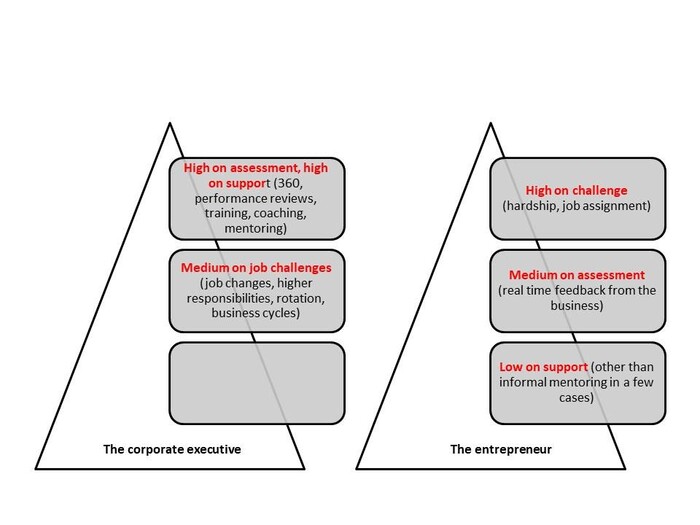
You can see that the average corporate executive is high on assessment and support and medium on challenge. What does this mean? Please note – High on assessment and support and medium on challenge. Support mostly matches challenge.
That means, the corporate executive works in an environment where there is a system of regular performance feedback in addition to the opportunity to periodically participate in formal assessment processes keeping development in mind. It also means that these executives have the opportunity to participate in a wide variety of level appropriate development programs in addition to access to formal coaching and mentoring.
On the other hand, except for a few executives and except for certain difficult business times, the kind of challenge they face is never completely disproportionate to their level or capacity.
The entrepreneur is on the other hand high on challenge and medium on feedback and low on support. What does this mean? Please note – High on challenge and low on support.
The most potent developmental experience in Coaching Entrepreneurs is his or her job challenge and a huge dose of hardship. Often, these hardships and challenges come in at an age that is often too early and when they are too unprepared. In that sense, these experiences are hugely developmental.
However, these experiences are also like being thrown into the deep end of the pool and being expected to swim.
They have very few opportunities for formal feedback, opportunities to enhance self-awareness and obtain external benchmarks on their competencies and style.
They also lack access to timely support from programs and people.
Now, here is an added complexity – central to the so called entrepreneurial spirit is the trait of setting out to do things unmindful of limitations in resources, internal and external. That is what propels entrepreneurship.
That in many ways sums up the unique context of the entrepreneur and why support in the form of any helping or developmental relationship will be invaluable.
What kind of developmental relationships will help?
It must be clarified right away that any such help cannot be a one-time fix. One of the common perceptions about coaching or mentoring or any other support is that it is like a vaccination you administer to infants, once in a life time.
Like corporate executives, coaches will need access to different kinds of developmental relationships at different stages in their journey of growth to address different agendas.
This is where those in the helping profession and the entrepreneurs seem to miss the point.
Here is a model that I would like to suggest as a way of looking at a range of helping relationships combined with developmental experiences at various stages of the entrepreneur’s journey. Specifically, this model looks at a combination of assessment and support, given that challenge is available in plenty already.

Mentoring
Mentoring is an invaluable source of support at a time when entrepreneurs are ideating about starting a business. In addition to the obvious mentoring support on aspects of business, they need mentoring on the emotional and interpersonal dimensions and get a sense of what to expect. This would be in the form of guidance, shared personal experiences, role models to emulate and even some tough advice.
Such mentoring support can often continue for a long time and from different sources, each from one lens and one vantage point.
Assessment
Entrepreneurs need critical development feedback to understand their strengths and some of their potential derailers. Co-founders who were great hostel mates can get entangled in bitter irreconcilable differences simply because a social relationship does not sustain in a business setting. Such assessment needs to come as soon as they get started rather than later.
Such assessment support must almost be like an annual health check-up serving as indicators for the present and the future.
The very nature of such actionable assessment will necessitate perhaps an executive coach with contextual knowledge. Someone who can not only assess but also de-brief with care and then support in coming up with simple actions.
Coaching
As the entrepreneur begins to scale and the issues of organisation and leadership surface, he or she will need support in developing those muscles and facing the road ahead. That is where a coach can become invaluable.
Who is suitable to coach and mentor and what should be the nature of the engagement?
This is where entrepreneurs can go terribly wrong. They are often not clear about what to look for in whom and end up embarking on a search that is designed to fail. “There isn’t anyone who exactly understands my unique situation and has been there and done that exact thing and so no one can understand me and help me and I have to do it alone” is what they would often tell themselves.
It is fair to expect mentors to have strong business and domain and contextual know-how. It is also fair to expect such mentors to be available on tap for spontaneous support. That is why mentors are more suitable in the early stages. However, such mentors need to have a certain level of training to uphold the true spirit of helping and not be seen as tormentors. They should also refrain from excessive advice and creating dependencies and aim to empower.
On the other hand, coaches should not even be from the same business because they will then be tempted to “solve the problem” and not “help the person”. They only need to have significant executive experience; have held senior positions and have a fair understanding of current business contexts but fully understand the tasks and demands of business leadership.
By setting up criteria that is unreal and unnecessary, entrepreneurs can end up deceiving themselves and coming in their own way of growth. By seeking help early, they can grow and enjoy the journey.
The role of investors
Investors (VCs and PEs) are in a unique position to be the sponsors for such developmental relationships. Those that enjoy the trust and have earned credibility are able to sponsor such a relationship by not just making an introduction but preparing the ground, setting the context and staying connected.
Such sponsors can play a crucial role in reducing resistance, creating readiness and encouraging participation and offering perspectives.
Without a sponsor the accountability to seek help and make changes may be somewhat muted.
For that to happen, VCs could also may benefit from getting educated about how such helping relationships work, what to look for, how to sponsor and so on. They can also take the time to ask the right enabling questions in their Board meetings.
The brave will invest in development
The world has seen several business cycles, economic ups and downs. In the throes of each of these cycles, the inevitable question is always asked – “should investment in development be part of the things we cut in order to optimize costs and conserve cash?”
Over the years, more and more businesses have begun to take a rather long-term and wise view about such developmental investments.
They have managed to focus on cost but also make available budgets for developmental investments that matter, thereby signaling that pay and benefits are a matter of economics and pay philosophy and people development is a matter of future development and driven by their people development philosophy.
However, the current pandemic seems quite different. The situation is far from stable and the decision making process is also far from simplistic. The fact that the Indian economy has contracted by over 23% in Q1 says it all.
I spoke to a cross section of thought leaders, consultants and business and HR leaders within organisations and asked them why developmental spends across most organisations seem to have come to a grinding halt? Why were even those organisations which traditionally took a long-term visionary view to such investments, cutting back quite significantly?
Organisational philosophies as driving forces and Business realities as restraining forces
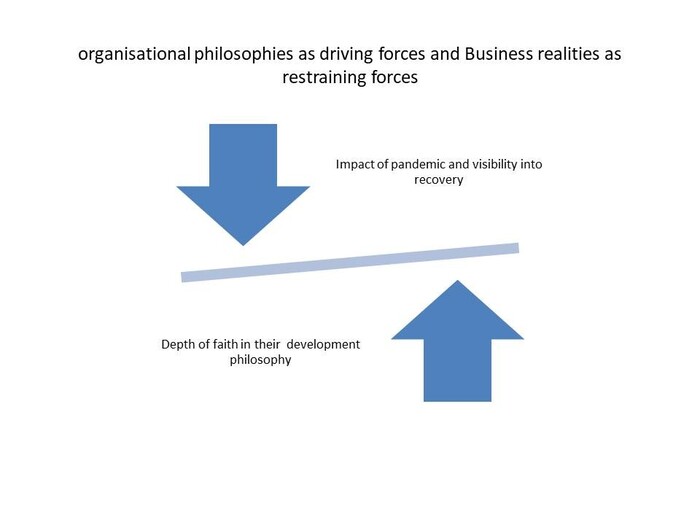
On one side are the philosophical orientations of organisations in terms of commitment to development and a track record of having taken a wise and long-term view to development on previous occasions. These are the driving forces.
On the other side are the hard business realities where businesses are battling serious crisis and are fighting to stay afloat and conserve cash. These are the restraining forces.
In the past, organisational philosophies did positively influence developmental investments in quite a number of instances. One would imagine that like in the past, organisations with a strong philosophy would have continued to take a long-term view.
My own research tells me that the situation this time around is quite different. My first and rather unfortunate conclusion is that business realities beat philosophy, at least this far.
It appears that even organisations with a very strong commitment to development are struggling in the face of hard business realities and are cutting back on their usual development spends.
Hard decisions
Conversations with business leaders reveal that many of the businesses which have been deeply impacted and are staring at unprecedented Q1 losses and grim prospects for most of the year have had to take many harsh decisions and actions to conserve cash. They have had to lay off employees, implement a variety of pay cut programs in addition to stopping promotions and implementing other measures to conserve cash.
Of course I did find exceptions to this rule. I found organisations avoiding pay cuts and resisting layoffs.
The flexible staffing program implemented by many organisations does not seem adequate. There is a need to go beyond this and look at the permanent workforce. Why this was the case and what struggles they are going through to get the flexible workforce back is an entirely different subject.
Don’t waste a good crisis
Then, there are organisations that may or may not have been impacted deeply by the pandemic but may be using the opportunity to implement some of the long pending rationalization measures like rationalization of structures, roles, layers, changing promotion policies or just shedding excess staff.
The two logic bubbles
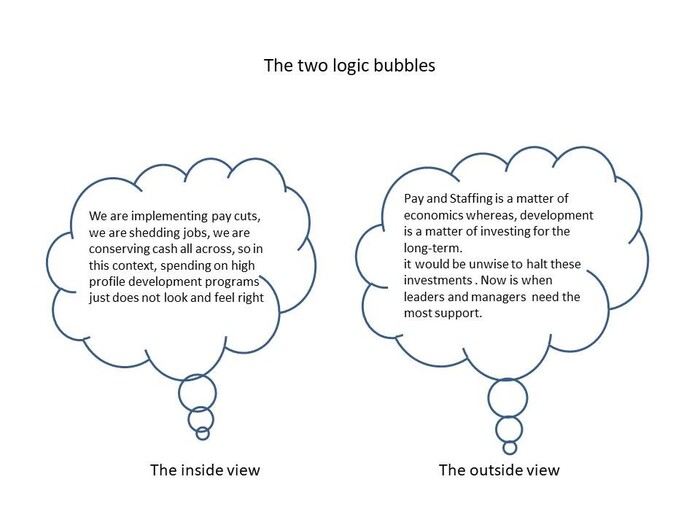
Clearly the view of those looking at organisations form the outside is quite different from the views of those actually running organisations and understandably so. Let me say, they are operating from their respective logic bubbles and both appear very valid. (A logic-bubble, according to de Bono, is that bubble of perception within which a person is acting. When one person’s perspectives are different from the other, it does not mean they are wrong. It could be that their perspectives are as well-founded as the other’s when considered within their particular logic-bubbles.)
Those viewing the situation from outside seem to take the view that Pay and Staffing is a matter of economics whereas, development is a matter of investing for the long-term. Their view is that it would be unwise to halt real developmental investments because this is the time when leaders and managers and employees need the most support to succeed.
Those from within maintain that they are implementing pay cuts, are shedding jobs, are looking at every small opportunity to conserve cash all across and in this context, spending on high profile development programs just does not look and feel right. Some of them also maintain that they have opened up a plethora of online courses and resources and employees are free to access and use them. The belief is that these resources are an immediate substitute to the erstwhile development.
The real nature of development
Having explored the current pandemic and its impact on business and development from a few vantage points, it is now time for us to understand and define the nature of developmental investments that really matter. Unless we do that, we will not be in a position to determine if such investments can be deferred or are needed now.
Way back in the year 2011 ,in my book titled, “Creating a Helping organisation – five engaging ways to promote employee performance, growth and well-being.” I had asked the question, “Are today’s organisations able to promote employee performance and business growth along with employee well-being or is the pursuit of performance and growth taking its toll on employee well-being?” Even back in 2011, I felt increasingly concerned about the unintended consequences of performance and growth impairing employee well-being.
Today, the situation is so complex, so challenging and so uncertain that more and more in the world of business are experiencing this reality of imbalance on a daily basis.
While everyone is battling the physical threats of covid – 19 on a daily basis, they are battling an even more serious threat every single day. That threat has to do with the huge mismatch between the demands placed on them to perform against all odd and the resources at their disposal to deliver such results.
More and more experts are seeing an unprecedented mental health crisis looming large among people young and old given the challenges of living; leave alone the challenges of working. With no vaccine or cure in sight, employees are facing huge uncertainties in their personal lives. Add to this the business uncertainties and add to that the demands placed on them.
If organisations wish to secure break-through results in such a context, it is my view that they will need to embrace an entirely new and fresh approach to leadership and people management.
Leaders and managers who are themselves battling their personal challenges and uncertainties will need help and guidance to learn and embrace a new way of managing their teams – a way that is built on a humanistic foundation.
Given the current situation, I see six critical imperatives for leaders and managers to manage their teams in the days to come:
- Focus in the face of ambiguity
- Resources in the face of shortages
- A flexible style in the face of pressure
- Relationship before task
- Asking when it is easier to tell
- Deal with the issue and not the person
Against this backdrop, it is my view that developmental investments in the current context need to go beyond form and fancy. They need not be expensive long-term programs based on complex competency frameworks. We do not need more assessment and development centre results to tell managers and leaders what ails them.
If we believe that the world has been disrupted and altered in an almost irreversible manner and the way we live has also begun to change, it is but natural that the way we manage and lead has to change. That is where developmental investments need to be made.
Now, it will call for more than wisdom to make those decisions. It will call for the courage to swim against the tide of common opinions to make the decision to invest in empowering managers and leaders so that they and their teams can embrace the emerging new world, in an all new way!
Exec. Coaching in India, the right time
As more and more individuals contemplate becoming a coach and more and more contemplate opening institutions to train coaches and others contemplate building a coaching based leadership development or personal development practice, there are searching questions being asked about whether we have too many coaches and we have too few opportunities, whether the commoditization and price wars have begun and of course if this is worth all the effort. Worse some are picking up worried questions being asked around the world – is coaching broken.
Having become a coach in 2001 and co-founded CFI, a Leading Leadership
Coaching institution in India in 2006 , I believe it is important to try and answer these questions in as accurate a way as I can.
First, coaching in India is currently well poised – it isn’t broken for sure. What we do from now on will determine its future.
How many coaches are there in India?
It is my own estimate that CFI, ICF, CCL and a few other institutions put together may have contributed to the creation of not over 2000 trained and certified coaches in India. Add to this a small number of coaches who might be coaching based on their sheer professional credentials and personal reputation without a certificate as well as some international coaches operating in India. So, lets take 2000 as a good number for our discussion.
I am excluding from this, those certified in in-company programs as coaches as a part of a leader as coach or Manager as Coach program to build a coaching culture. I am also excluding those who attended a skills program but did not do an internship and practice that was supervised.
Of this number of 2000, it is my view that not over 25% – that is 500 coaches might be in active executive coaching practice. The remaining 1500 are unable to find opportunities or never tried to find opportunities or lost interest or just did it as a part of their personal development.
Also, unlike in other countries, many of these coaches don’t JUST do coaching – they do other things too – consulting, advisory work, training, teaching, counseling, healing, sitting on board and so on.
How many executive coaching opportunities are there in India?
This is an interesting question. It is my estimate that in a year there are about 1500 classical executive coaching opportunities. Does this number surprise or shock you? Yes, that is the number according to me. Remember, executive coaching is offered only at the CXO levels and most often an executive who is a coachee does not seek coaching more than once in a very very long time.
Now if you put the two together you might see an interesting picture emerging – 500 coaches and 1500 opportunities – some successful coaches doing multiple assignments in a year and some doing one or two in a year or two.
It must also be remembered that most executive coaches also have a “salience period” – a period when their professional credentials are valued and their coaching skills sharp and their practice thriving. It is like a cricketer in form. With age, some coaches do lose the energy and interest and the edge. Some of course keep marching on with great energy and zest.
Now considering the fact that the number of coaches has grown maybe seven-fold in the last 5 years, an extrapolation will make the next 5 years look challenging. If India were to see about 10,000 coaches in 2026, will they have on an average at least one opportunity per head per year?
What will be the shape of coaching in the years to come?
The answer to this question is complex but it will depend a lot on the way coaching will evolve in the years ahead.
It is my view that the classical executive coaching model that we have seen will continue to grow but not grow in large numbers in the years to come.
On the other hand, it is a firm reality that executives in corporate India need help and support to manage their work and their lives and they need it urgently. However, such help will need to take much more innovative, flexible and more nimble forms.
Institutions and individuals who are able to come up with development solutions that have an individual coaching element built into them creatively will be able to meet these fast-emerging needs. More importantly it will create a huge ground swell of demand for coaching talent, albeit in a different form.
The right time
Now is the right time for India to consciously shape the next stage of evolution of coaching based on the experience of the last two decades and ensure that the integrated and holistic Indian coaching model shows the way to the rest of the world.
Now is also the right time for India to get its coaching practice right before it runs into either commoditization or price wars to unethical and inappropriate application or sheer proliferation.
Institutions that are training aspiring individuals to become coaches need to pay attention to quality and relevance and not just sheer numbers. We all recognize that coaching is like any other professional practice (lawyers, doctors, architects). It is not the credentials that matter – it is the competence. The focus must be on competence building and not sheer credentialising. The deeper focus must be on the “being” of a coach”. (being empathetic, being congruent and offering unconditional positive regard without being judgmental, in the words of Carl Rogers).
Individuals wanting to become coaches need to seek good counsel before making a choice – certainly not imagine this to be a lucrative profession because it certainly is not.
Leadership institutions need to be innovative in the manner in which they embed coaching into their development solutions. Given our demographic profile, coaching must reach younger employees sooner and not be burdened by “entitlements” and “rank”. They are going to run corporate India very soon if they already are not.
Existing coaches need to recognize that continuing professional development is critical to their sustained success and this will call for some selfless service to fellow professionals in aiding their journeys of development.
Clients and sponsors would do well to invest in their own literacy about these aspects so that they can make well informed choices about the right solution and the right partners.
In all of these decisions, the coachee must be at the very heart of the matter – we need to be truly coachee centric in order to get this right!
Given the early trends in the industry and of course going by what we at CFI have been doing, I remain optimistic about the next five years! The Indian model can lead the way!